
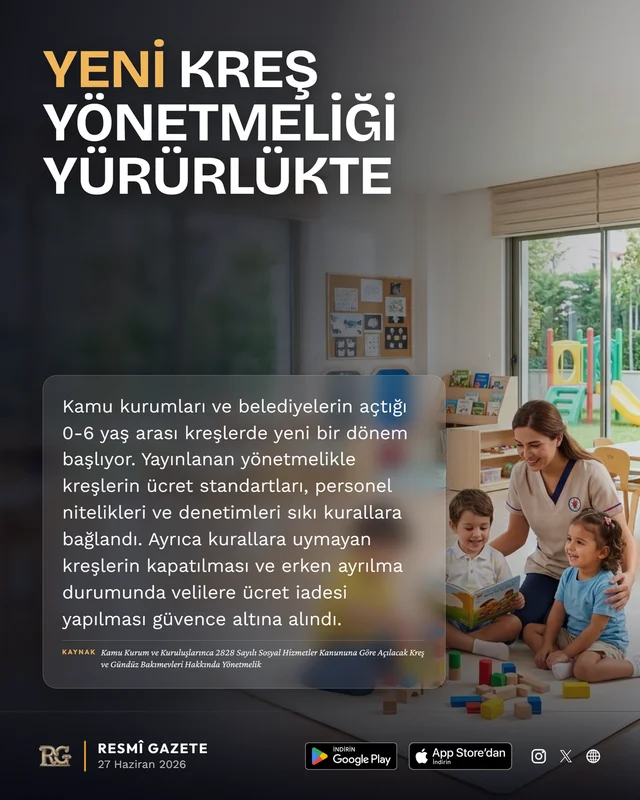
New Daycare Regulation in Force
Official titleRegulation on Daycares and Day Nurseries to be Opened by Public Institutions and Organizations Pursuant to Social Services Law No. 2828
This Regulation published by the Ministry of Family and Social Services regulates the procedures and principles regarding the opening, operation, supervision, personnel, and pricing of daycares and day nurseries to be opened by public institutions and organizations as well as local administrations pursuant to Social Services Law No. 2828.
Details of the Regulation
The Regulation brings about wide-ranging provisions for daycares and day nurseries aimed at children in the 0-6 age group, covering establishment processes, service, operational, and personnel standards, supervision mechanisms, closure conditions, and pricing principles. These regulations cover institutions to be opened by the Ministry of Family and Social Services and public institutions and organizations pursuant to the powers granted under Metropolitan Municipality Law No. 5216 dated 10/7/2004, Municipality Law No. 5393 dated 3/7/2005 to local administrations, and relevant laws. However, child nurseries within the scope of Article 191 of Civil Servants Law No. 657 are excluded from the scope of this Regulation.
In the opening and operation of institutions, the provisions of the Regulation on the Principles of Establishment and Operation of Private Daycares and Day Nurseries published in Official Gazette No. 29342 shall apply, provided that they are compatible with public service. Audits shall be conducted by provincial directorates and, when necessary, by the Ministry; supervision of educational programs belongs to the Ministry of National Education. A time period shall be granted to institutions for deficiencies detected as a result of audits; if not remedied, additional time shall be granted, and ultimately a decision for closure may be taken. In serious situations, such as threats, pressure, or harmful actions by the director of the institution, the institution may be closed directly.
Fees shall be determined by the relevant public institution or organization and cannot be lower than the floor limit set by the Ministry of Treasury and Finance. Local administrations shall decide through their own councils on whether to charge a fee for the service and the amount thereof. Refunds of fees paid in cases of long-term illness or departure of the child are also guaranteed by the Regulation. All institution, personnel, and child information shall be tracked in the information system maintained by the Ministry and in the Ministry of National Education's e-Okul system. Existing institutions are obliged to apply for opening approval and comply with the provisions of the Regulation within six months from the date of publication of the Regulation.
Questions You Might Have
- Which age group of children does this Regulation affect, and is there any special situation excluded from its scope?
- The Regulation affects children in the 0-6 age group. Child nurseries within the scope of Article 191 of Civil Servants Law No. 657 are outside the scope of this Regulation.
- What kind of transition process is envisaged for existing public daycares or day nurseries?
- Existing institutions must apply for opening approval and comply with the provisions of the Regulation within six months from the date of publication of the Regulation.
- What happens if the deficiencies detected in the audit of a public daycare are not remedied?
- For detected deficiencies, a period not exceeding 30 days is given first. If not remedied within this period, an additional 30 days are granted. If they are still not remedied despite the additional period, the institution shall be closed.
- How will the fees for child nurseries be determined, and is a fee refund possible for absenteeism due to illness?
- Fees shall be determined by the relevant public institution or organization, but cannot be less than the fee set by the Ministry of Treasury and Finance. In cases of absenteeism due to illness lasting 15 business days or longer, fees covering the period for which the child holds a medical report shall be refunded.
Key Terms
- Kreş ve Gündüz Bakımevi
- Non-residential social service institutions established to provide care for children in the 0-6 age group, protect and improve their physical and mental health, and impart basic values and habits to them.
- Komisyon
- A commission consisting of at least three people, established with the approval of the governorship, to take decisions regarding the audit, evaluation, and closure of institutions.
- 2828 sayılı Sosyal Hizmetler Kanunu
- The law containing fundamental provisions regarding the delivery of social services and the operation of social service institutions.
Affected Sectors
- Public administration
- Local administrations
- Social services
- Education
- Families
Where we posted this
Follow Turkish legal developments
REGAS analyzed all 31 items in the Official Gazette of 27 June 2026; we published only 3 of them here.
REGAS summarizes every change in the Turkish Official Gazette in plain language and notifies you.
The REGAS app is currently Turkish-only. If you would like English in the app, the best way to make it happen is to support the developer: get the app and just say so.


REGAS Commentary
By establishing a standardized framework in daycare and day nursery services provided through the public and local governments, this Regulation aims both to ensure that children receive care and education in a higher quality and safer environment and to set clear rules for service providers. In particular, the audit processes and the time periods given for the remediation of deficiencies are important steps towards improving service quality. For families, matters such as fee policies and fee refunds in cases of absenteeism/departure offer a certain financial transparency and assurance. Furthermore, the determination of qualifications and job descriptions of personnel, alongside provisions for rapidly initiating legal proceedings in cases of child abuse or neglect, demonstrate the sensitivity towards the protection of children.