
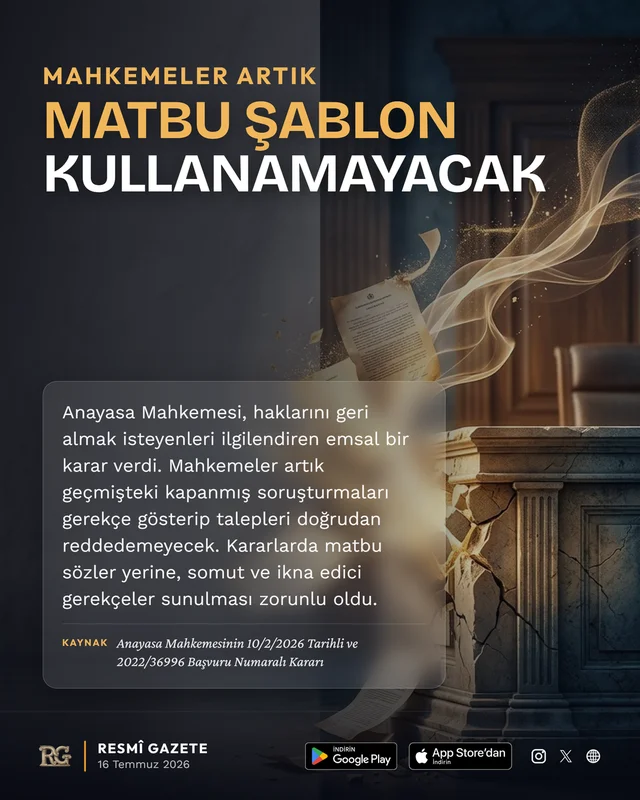
Courts Will No Longer Be Able to Use Formulaic Templates
Official titleDecision of the Constitutional Court dated 10/2/2026 and Application No. 2022/36996
This is a decision of the AYM regarding the violation of the 'right to a reasoned judgment' due to the rejection of the applicant's request for the restoration of forfeited rights based solely on investigations that resulted in non-prosecution decisions and without providing sufficient explanation.
Details of the Regulation
The applicant applied to the Yumurtalık Criminal Court of First Instance requesting the restoration of forfeited rights (reinstatement of banned rights) due to past convictions. The court rejected the request on the grounds that a positive impression regarding the applicant being 'of good conduct' had not been formed, citing certain ongoing investigations or investigations that had resulted in non-prosecution decisions against the applicant.
In its examination, the Constitutional Court determined that the lower courts did not discuss the contents of these investigations or their impact on the applicant's legal standing, but instead ruled with a formulaic justification based solely on the number of investigations. The court's failure to address the favorable arguments presented by the applicant and its failure to associate the state of 'not being of good conduct' with concrete data were evaluated as a violation of the right to a reasoned judgment within the scope of the right to a fair trial.
As a result, the AYM sent a copy of the decision to the Yumurtalık Criminal Court of First Instance for a retrial to eliminate the consequences of the violation. The applicant's claim for non-pecuniary damages was rejected on the grounds that the finding of a violation would provide sufficient redress.
Questions You Might Have
- Why did the applicant allege a violation of rights?
- Because, despite the investigations against them ending in non-prosecution, the court considered these as indications of 'bad conduct', rejected the request, and failed to adequately explain this reasoning.
- Why was the court's rejection decision found to be contrary to the Constitution?
- Because it presented a formulaic justification that failed to address the applicant's arguments, did not discuss concrete data, and merely stated that 'good conduct was not established.'
- What will happen after this decision?
- The Yumurtalık Criminal Court of First Instance will re-evaluate the applicant's request taking into account the AYM's grounds for violation.
Key Terms
- Memnu Hakların İadesi
- The process of restoring certain rights (right to be elected, public employment, etc.) lost by a person due to a conviction, subject to certain conditions.
- Gerekçeli Karar Hakkı
- The obligation of courts to explain the reasons for their judgments based on evidence and legal grounds.
- Masumiyet Karinesi
- The principle that a person accused of a crime is presumed innocent until proven guilty by a court decision.
- Matbu Gerekçe
- Stereotypical and general expressions that do not contain the specific facts of the case and can be applied to any similar case.
Where we posted this
Follow Turkish legal developments
REGAS analyzed all 43 items in the Official Gazette of 16 July 2026; we published only 3 of them here.
REGAS summarizes every change in the Turkish Official Gazette in plain language and notifies you.
The REGAS app is currently Turkish-only. If you would like English in the app, the best way to make it happen is to support the developer: get the app and just say so.


REGAS Commentary
This decision demonstrates that judicial authorities, when rejecting requests regarding individuals, cannot settle for general and superficial expressions such as 'there is an investigation in the file.' In particular, files that resulted in non-prosecution or have uncertain content are prevented from being used as an automatic barrier to restrict a person's future rights. For thousands of citizens awaiting the restoration of forfeited rights, this decision is an important precedent confirming that courts must present more meticulous and concrete reasoning.