
Uninterrupted Air Inspection for Miners
Official titleRegulation on the Amendment of the Regulation on Occupational Health and Safety in Mining Workplaces
The amendments made to the Regulation on Occupational Health and Safety in Mining Workplaces aim to enhance occupational safety by clarifying, in particular, the definitions and requirements regarding ventilation systems and backup power sources in underground mine pits.
Before
Definitions regarding main and auxiliary ventilation fans and backup power systems were lacking. The obligation for backup auxiliary ventilation fans in firedamp mine pits and the connection of main ventilation fans to a backup power system were not explicitly specified. There was no requirement for monthly testing and recording of backup ventilation fans.
After
Definitions for main ventilation fan, auxiliary ventilation fan, backup power system, and backup ventilation fan have been added. It has been made mandatory for the main ventilation fan to be connected to a backup power system. In firedamp mine pits, the requirement to keep a backup auxiliary ventilation fan, prepare installation instructions, and assign personnel has been introduced. Evacuation and safety precautionary measures in the event of fan failure in areas with auxiliary ventilation have been detailed. The obligation to maintain a backup ventilation fan equivalent to the main ventilation fan in all firedamp mines and to conduct and record its monthly tests has been introduced.
Details of the Regulation
The regulation amendment published by the Ministry of Labour and Social Security introduces significant updates to the Regulation on Occupational Health and Safety in Mining Workplaces published in the Official Gazette dated 19/9/2013 and numbered 28770. Within the scope of these amendments, definitions of key terms such as "Main ventilation fan", "Auxiliary ventilation fan", "Backup power system", and "Backup ventilation fan" have been added to Article 4 of the regulation. These definitions clarify the scope and function of ventilation and emergency systems in mines.
With the amendments made to Annex-3 of the regulation, it has been made mandatory for the main ventilation fan to be connected to a backup power system in addition to the main power system. Furthermore, in firedamp mines, the requirement to keep a backup fan to be used in case of failure of the auxiliary ventilation fan, to establish installation instructions, and to assign designated employees has been added. Critical safety measures, such as the immediate evacuation of employees if the fan becomes deactivated in areas with auxiliary ventilation and not re-entering the area until adequate air is provided, have also been detailed.
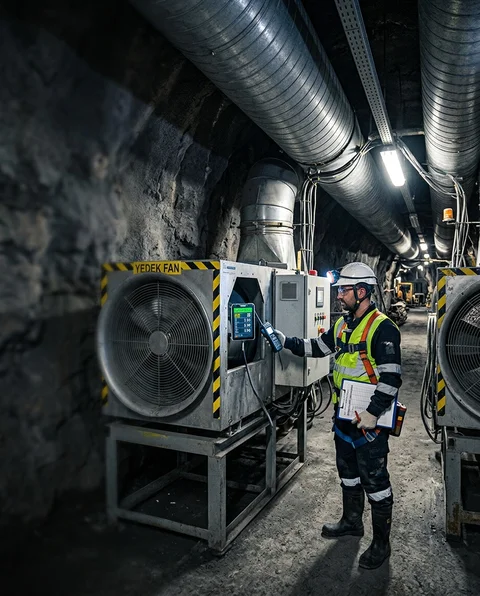
One of the most significant amendments is the obligation to maintain backup ventilation fan(s) equivalent to the main ventilation fan(s) in all firedamp mines. In the event that the main fan stops, the backup fan will be ensured to activate immediately, and the continuity of this system will be recorded through tests to be conducted at least once a month. The precautionary measures to be taken during these tests shall also be specified in the health and safety document. These regulations aim to ensure preparedness against sudden failures in mines and to continuously maintain the safety of employees.
Questions You Might Have
- What does this amendment mean for miners?
- For miners, particularly in firedamp mines, the risks of suffocation or being subjected to dangerous gases during potential ventilation failures or power outages will be significantly reduced, which will provide a safer working environment.
- What must mining enterprises do to comply with these new regulations?
- Mining enterprises must connect their existing ventilation systems to backup power systems, procure backup auxiliary and main ventilation fans for firedamp mines, prepare installation instructions for these systems, assign relevant personnel, and conduct and record monthly tests of the backup fans.
- How will it be verified that the backup ventilation fans are in operational condition?
- Tests regarding whether the backup ventilation fans activate immediately in such a way as to ensure ventilation continuity shall be conducted at least once a month, and the results of these tests shall be recorded.
Key Terms
- Ana havalandırma fanı
- The main ventilator or aspirator that provides general ventilation in underground mining workplaces.
- Tali havalandırma fanı
- A fan used in specific areas where preparatory and rescue operations are conducted depending on the main ventilation flow.
- Yedek güç sistemi
- A generator or similar power system operating independently of the main electrical grid and capable of supplying the relevant systems when the main energy is interrupted.
- Yedek havalandırma fanı
- A backup ventilator or aspirator used in the event that the main ventilation fan becomes deactivated.
- Grizulu maden ocakları
- Mine pits where flammable and explosive gases, such as methane gas, are present.
- Vantüp
- An antistatic and flame-retardant flexible or rigid pipe used as a ventilation duct in mines.
Affected Sectors
- Mining
Where we posted this
Follow Turkish legal developments
REGAS analyzed all 33 items in the Official Gazette of 21 July 2026; we published only 3 of them here.
REGAS summarizes every change in the Turkish Official Gazette in plain language and notifies you.
The REGAS app is currently Turkish-only. If you would like English in the app, the best way to make it happen is to support the developer: get the app and just say so.


REGAS Commentary
This regulation amendment introduces critical regulations that directly affect the life safety of thousands of workers employed in mining workplaces. The uninterrupted operation of ventilation systems is of vital importance, particularly in firedamp (methane-bearing) mines. The obligation of backup power systems and backup ventilation fans aims to prevent loss of life by averting dangerous gas accumulation and oxygen deficiency that may occur in mines in the event of potential failures or power outages. Although these changes require additional investment and procedural updates for mining enterprises, they represent an indispensable step in terms of occupational health and safety. The requirement for monthly testing and recording will ensure the inspection of whether the system is continuously operational and safe.