
Sensor and Camera Requirement for High-Rise Building Demolitions
Official titleRegulation on the Amendment of the Regulation on the Demolition of Buildings
This is a regulation amendment re-regulating building demolition processes, particularly the technical and safety standards for the demolition of high-rise structures and demolitions involving the use of explosives.
Details of the Regulation
With this regulation amendment, technical supervision and safety measures in building demolition activities have been significantly tightened. It has been made mandatory for a civil engineer to assume technical supervision in all demolitions where explosives are used and in structures with a building height exceeding 18.50 meters. The definition of a high-rise structure has been updated, requiring "Selective Demolition" and special safety precautionary measures (screening, protective catch fans, covered walkways) for buildings over 21.50 meters.
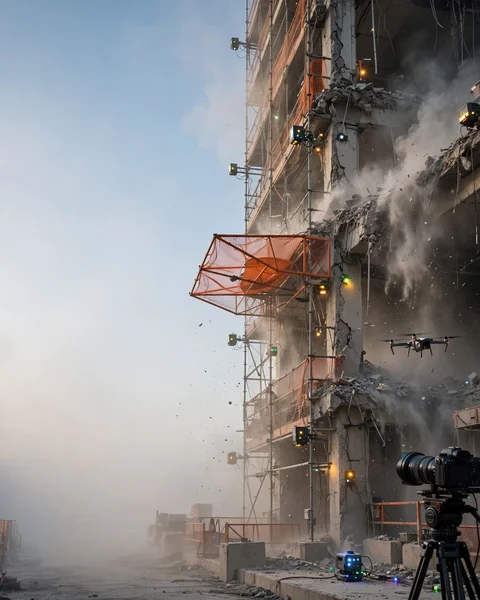
In demolitions to be carried out with explosives, the obligation to employ a "Blasting Engineer-in-Charge" and a "Blaster" has been introduced, and a rule requiring these operations to be recorded with high-speed cameras and monitored with vibration/pressure sensors has been added. Furthermore, it has been stipulated that demolition permit periods may be extended up to 3 months due to force majeure.
In demolitions carried out by public institutions, the requirement for a contractor and site manager has been lifted; however, the requirement for the technical supervision to be assumed by the institution has been imposed. Most of the regulation's articles containing technical requirements will enter into force one year after the date of publication.
Questions You Might Have
- How will neighboring buildings be protected when a building is demolished with explosives?
- Calibrated sensors measuring air shock and vibration will be used at the moment of blasting, and the process will be monitored with high-speed cameras.
- Is a civil engineer required in every building demolition?
- It is not mandatory for buildings with a height of less than 18.50 meters that do not pose a risk; however, it is mandatory for buildings above this threshold and for demolitions with explosives.
- What happens if the demolition period is not sufficient?
- In challenging circumstances such as row construction or high-rise structures, the permit period may be extended for a period of 3 months, specific to a single instance, subject to the approval of the administration.
Key Terms
- Seçici Yıkım
- The controlled dismantling process carried out by sorting hazardous and recyclable wastes prior to demolition.
- Fenni Mesuliyet
- The state of assuming technical responsibility that the structure is constructed/demolished in accordance with the legislation and its project design.
- Müellif
- The authorized civil engineer who prepares the demolition plan and assumes responsibility for it.
Where we posted this
Follow Turkish legal developments
REGAS analyzed all 27 items in the Official Gazette of 12 August 2026; we published only 3 of them here.
REGAS summarizes every change in the Turkish Official Gazette in plain language and notifies you.
The REGAS app is currently Turkish-only. If you would like English in the app, the best way to make it happen is to support the developer: get the app and just say so.


REGAS Commentary
Demolition safety in urban transformation and building renovation processes is being raised to the highest level. Environmental risks (dust, noise, vibration) will be managed more professionally, especially for citizens living in row-construction buildings. Engineering firms and demolition contractors will require new certifications and investment in technological infrastructure (sensors, cameras).