
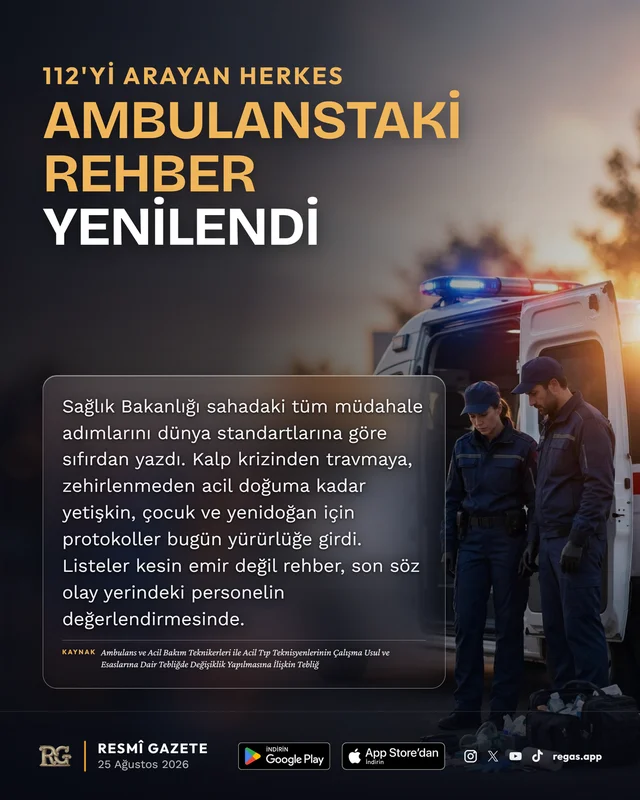
Everyone Calling 112 Updates the Guide in the Ambulance
Official titleCommunique Regarding Amendments to the Communiqué on the Working Procedures and Principles of Ambulance and Emergency Care Technicians and Emergency Medical Technicians
Sağlık Bakanlığı completely updated the medical flowcharts (Ek-2) that ambulance and emergency medical personnel must follow when responding to cases, in light of current scientific data.
Before
The former medical intervention algorithms, which had been revised since 2009, had been used.
After
Comprehensive intervention flowcharts distinguishing between adults and children, renewed in accordance with current scientific data and field requirements, have entered into force.
Details of the Regulation
Through this communiqué published by Sağlık Bakanlığı, the most critical section of the principal legislation dated 26/3/2009, “Ek-2: Prehospital Emergency Medical Assistance and Care Flowcharts,” has been replaced in its entirety. The amendments bring the medical protocols to be applied by emergency medical technicians (ATT) and technicians (Paramedik) working in ambulances up to date, from the moment they arrive at the scene until the completion of the hospital transfer process.
The new annex contains step-by-step intervention algorithms separately prepared for adults, children, and neonates for numerous emergency scenarios, including arrest management, heart attacks, poisoning, trauma, emergency childbirth, burns, and bites. These flowcharts are based on internationally accepted, up-to-date guidelines and field requirements and are equipped with technical details ranging from drug dosages to the order of interventions.
One of the most important points emphasized in the communiqué is that these algorithms are guides rather than binding and definitive instructions. Those applying them are required to make decisions in accordance with their professional knowledge and clinical assessments, based on the specific circumstances of each case. The new flowcharts entered into force as of the communiqué’s publication date, 25 August 2026.
Questions You Might Have
- Do these flowcharts turn ambulance personnel into robots?
- No. The communiqué clearly states that personnel have the authority to make clinical decisions according to the circumstances of each case and that the flowcharts are guides.
- How will this amendment affect me as a citizen?
- It ensures that you can be assured that the methods applied to you when you need emergency medical care are carried out in accordance with the latest medical findings and safe methods.
- Will the new flowcharts be implemented immediately?
- Yes. The communiqué entered into force on its date of publication (25 August 2026).
Key Terms
- Resüsitasyon
- The medical procedure for restoring arrested breathing and circulation (resuscitation).
- Algoritma
- The step-by-step sequence of operations followed to solve a problem or achieve an objective.
- Ek-2
- A supplementary document annexed to the legislation, generally containing technical details or lists.
Affected Sectors
- Healthcare services
- Emergency medical intervention
- Ambulance services
- Public health
Where we posted this
Follow Turkish legal developments
REGAS analyzed all 24 items in the Official Gazette of 25 August 2026; we published only 1 of them here.
REGAS summarizes every change in the Turkish Official Gazette in plain language and notifies you.
The REGAS app is currently Turkish-only. If you would like English in the app, the best way to make it happen is to support the developer: get the app and just say so.


REGAS Commentary
This regulation directly affects the quality and legal certainty of 112 emergency healthcare services. For healthcare personnel, these flowcharts provide the medical and legal basis for the procedures they carry out during interventions. For citizens, the aim is to ensure that, wherever they may be in Türkiye, they receive the most up-to-date and standardized medical intervention in an emergency. In particular, updates to drug dosages and the order of interventions may increase survival rates in critical cases.