
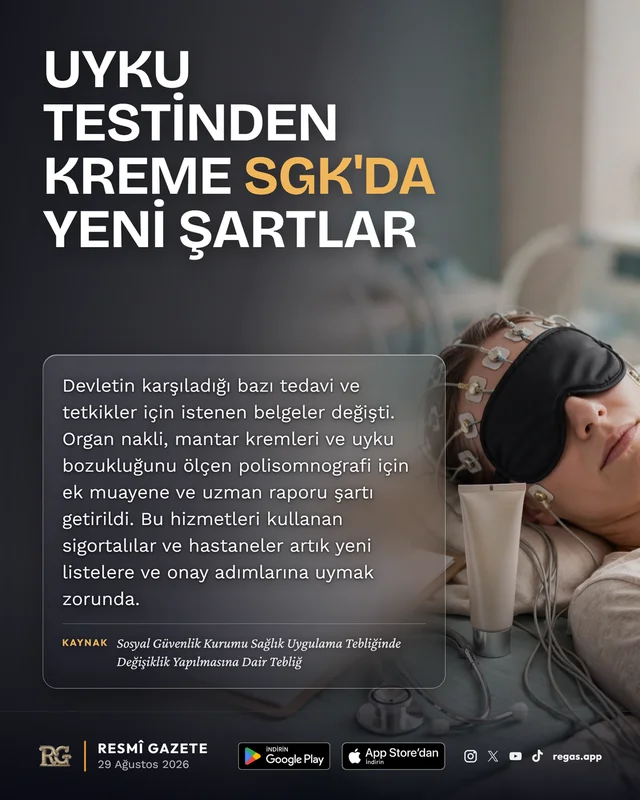
New Conditions for the Sleep Test at SGK
Official titleCommunique on Amending the Health Application Communiqué of the Social Security Institution
The extensive amendments made to the Health Application Communiqué (SUT) of the Social Security Institution have introduced detailed regulations concerning organ transplants, drug payment conditions, radiological examinations, and various medical procedures. The communiqué establishes the new rules and payment criteria that insured persons and healthcare providers must comply with.
Before
The payment conditions concerning organ and tissue transplants, certain drugs, radiological examinations, and sleep studies were in force under the previous version of the Health Application Communiqué of the Social Security Institution. In particular, the payment and use conditions for bone marrow and tissue banks and certain topical drugs were less detailed. Certain examinations and treatment methods did not involve specific ICD-10 codes or approval processes, or were implemented differently. The “List of Drugs for Which the Full Amount Will Be Reimbursed” and the “Diagnosis-Based Conditional Drug List” were applied in their previous formats and with their previous contents.
After
With the amendments made to the SUT, the payment criteria concerning bone marrow tissue banks and tissue groups for organ and tissue transplants have been expanded, and the requirement for ethics committee approval has been further detailed. Additional conditions of use, such as a dermatological examination and specialist physician approval, have been introduced for the reimbursement of certain drugs, including topical antifungals and antiseptics. Special conditions of use and monitoring have been added for nucleoside agents used in the treatment of certain chronic diseases. New payment codes and detailed conditions of use have been established for radiological examinations, including thoracic examinations, radiology, and neurosurgery, as well as for sleep studies, including polysomnography. In addition, the drug payment and supply processes have been revised through updates to the “List of Drugs for Which the Full Amount Will Be Reimbursed (EK-4/A)” and the “Diagnosis-Based Conditional Drug List (EK-4/D).” Most of the provisions will enter into force on 29 August 2026, while certain drug list amendments will enter into force on later dates.
Details of the Regulation
By making significant amendments to the Health Application Communiqué (SUT) of the Social Security Institution, this communiqué restructures the provision of healthcare services and the payment processes. The amendments primarily focus on areas such as organ and tissue transplants, drug payment conditions, radiological and laboratory examinations, and sleep studies. For example, the payment conditions for bone marrow and tissue banks have been updated, new criteria have been introduced for the validity of tests, and the requirement for ethics committee approval has been further detailed.
In the drug payment system, additional requirements, such as a dermatological examination and specialist physician approval, have been introduced for the reimbursement of certain drugs, particularly topical antifungals and antiseptics. The payment conditions for certain drugs have been revised through updates to the “List of Drugs for Which the Full Amount Will Be Reimbursed (EK-4/A)” and the “Diagnosis-Based Conditional Drug List (EK-4/D).” This means that patients must comply with new procedures to access certain drugs. In addition, special conditions of use and monitoring have also been introduced for nucleoside agents used in the treatment of certain chronic diseases.
In the field of radiological and laboratory examinations, new codes have been added, or the payment conditions for existing codes have been further detailed, in various specialties, including thoracic examinations, neurological diseases, pediatric chest diseases, and sleep studies. This increases the technical requirements that healthcare providers must comply with when invoicing these examinations. Detailed payment conditions and technical standards have also been established for tests such as polysomnography in sleep studies.
Questions You Might Have
- What are the new payment requirements for bone marrow or tissue transplants?
- Under the SUT, additional criteria have been introduced for the expenses of bone marrow tissue banks and tissue groups to be reimbursed, including the requirement that the relevant tissue bank have been actively operating for at least 30 days and have passed an inspection in Türkiye.
- What additional documents or approvals will be required for the reimbursement of certain topical antifungal drugs?
- Additional requirements, such as a dermatological examination establishing the diagnosis and a health report prepared by the relevant physician, will now be sought for the reimbursement of certain topical antifungals and antiseptics.
- How does the new communiqué affect the “polysomnography” test used in the diagnosis of sleep disorders?
- Detailed technical and diagnostic criteria have been established for the reimbursement of polysomnography tests, including the requirement that a report be prepared by a specialist physician in one of the following specialties: “eye diseases, pediatric chest diseases, neurology, pediatric neurology, mental health and disorders, child and adolescent mental health and disorders.”
- When will these amendments enter into force?
- In general, the communiqué entered into force on 29 August 2026. However, different effective dates, namely 5 or 10 days later, have been specified for certain special provisions, such as those concerning drug lists.
Key Terms
- Sağlık Uygulama Tebliği (SUT)
- An official text published by the Social Security Institution that regulates which healthcare services healthcare providers will provide, under what conditions, and at what fees.
- Kemik İliği Doku Bankası
- An institution where tissues taken from donors for use in bone marrow and stem cell transplants are stored and managed.
- ICD-10 Kodu
- A coding system that categorizes diseases and health problems according to the 10th revision of the International Statistical Classification of Diseases and Health-related Problems.
- Polisomnografi
- A test used in the diagnosis of sleep disorders in which numerous physiological parameters, such as brain waves, eye movements, muscle activity, heart rate, and breathing during sleep, are recorded.
- Nükleosit Maddesi
- Chemical compounds used in cancer treatment that are building blocks of genetic material.
Affected Sectors
- Healthcare
- Insurance
- Pharmaceuticals
- Hospitals
- Laboratories
- Medical devices
Where we posted this
Follow Turkish legal developments
REGAS analyzed all 38 items in the Official Gazette of 29 August 2026; we published only 3 of them here.
REGAS summarizes every change in the Turkish Official Gazette in plain language and notifies you.
The REGAS app is currently Turkish-only. If you would like English in the app, the best way to make it happen is to support the developer: get the app and just say so.


REGAS Commentary
This communiqué will have significant implications for both healthcare providers and insured citizens. Changes or additional requirements may occur in the conditions for accessing certain medical services and drugs for citizens. Additional approval processes or steps, such as a dermatological examination, may be required for specific treatments or drugs. Healthcare professionals and institutions, on the other hand, are now required to comply with the updated codes and conditions in the invoicing and reimbursement processes. Careful monitoring is necessary, as payment problems may arise if the new rules are not complied with.