
The State Will Pay the Damage Sustained by Those Going to Fight the Fire
Official titleRegulation on Work Regarding Combat Against Forest Fires
Through the regulation issued by the General Directorate of Forestry, the procedure and principles concerning the prevention and detection of forest fires, firefighting methods, use of aircraft, interinstitutional coordination, volunteer participation and compensation for damage have been regulated comprehensively.
Before
null
After
The distribution of duties among institutions in combating forest fires, the use of UAVs and aircraft, volunteer status, firefighting methods and compensation for damage have been made subject to detailed rules.
Details of the Regulation
The regulation provides a comprehensive legal framework for processes concerning the prevention of forest fires, risk reduction, fire preparedness, firefighting and post-fire rehabilitation. Through the regulation, the duties and responsibilities of the General Directorate of Forestry, AFAD, local administrative superiors, law enforcement forces, municipalities, the Ministry of National Education, civil society organizations and volunteers in firefighting processes have been clarified. During periods of high meteorological risk, local administrative superiors are granted authority to prohibit access to forests, while the precautionary measures that all actors, ranging from beekeepers and combine harvester operators to agricultural landowners and accommodation facility operators, must take have been determined.
The use of technology and the deployment of aircraft in firefighting operations constitute key elements. It is envisaged that unmanned aerial vehicle (UAV) control centers will be established and that fire-monitoring towers and technological communication infrastructure will be strengthened. Flight safety, tracking devices and coordination principles have been established for foreign or private aircraft participating in firefighting operations; aircraft in the OGM inventory may be assigned to fires outside forests, provided that their rental and flight costs are covered. Furthermore, law enforcement forces have been granted immediate authority to intercept unauthorized unmanned aerial vehicles (drones) that may endanger flight safety in the fire zone.
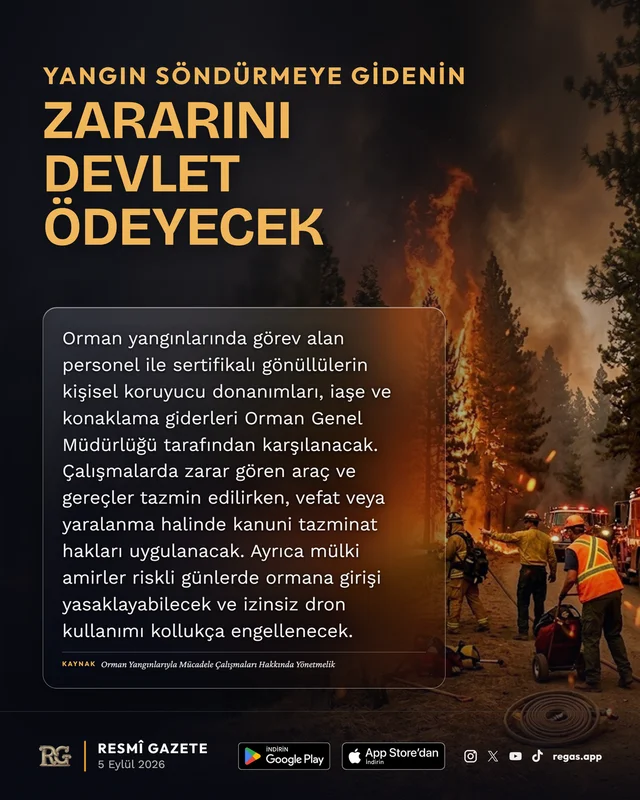
Direct intervention, parallel methods and the high-risk “backburning” technique have been defined among the intervention methods; it has been ruled that backburning may be carried out only under the responsibility of the fire commander or a fire expert to be assigned. During intervention, personnel on duty and certified volunteers are required to use personal protective equipment, while the costs of meals and accommodation are covered by the forest administration and vehicles and equipment damaged in the fire are compensated. It has been clarified that officials and volunteers who die, are injured or are permanently disabled during firefighting operations may benefit from the provisions of the Nakdi Tazminat ve Aylık Bağlanması Hakkında Kanun.
Questions You Might Have
- Is there any obstacle to flying a personal drone in the fire zone?
- Yes, the operation of drones and similar vehicles that endanger the flight safety of firefighting aircraft shall be prevented by law enforcement forces.
- Who pays the costs of machinery or vehicles damaged while assisting with a fire?
- Damage to vehicles and equipment documented as having been damaged in fires in state forests shall be compensated by the General Directorate of Forestry.
- Can access to forests be prohibited under critical weather conditions?
- Yes, during periods of high fire risk, access to forests may be prohibited by the Governor or District Governor, upon the request of the Forest Administration.
Key Terms
- Karşı Ateş
- An indirect firefighting method involving a high level of risk, applied with the aim of bringing combustible materials in the direction in which the fire is advancing under control by burning them in advance.
- Yangın Amiri
- Forest personnel authorized and responsible for dispatching and managing all administrative and technical interventions at the fire scene.
- Orman Yangınlarıyla Mücadele Gönüllüsü
- A person who has reached the age of 18, has been certified upon completing theoretical and practical training, and serves within the chain of command during a fire.
Affected Sectors
- Forestry
- Agriculture
- Tourism
- Aviation
- Defence and security
Where we posted this
Follow Turkish legal developments
REGAS analyzed all 45 items in the Official Gazette of 5 September 2026; we published only 3 of them here.
REGAS summarizes every change in the Turkish Official Gazette in plain language and notifies you.
The REGAS app is currently Turkish-only. If you would like English in the app, the best way to make it happen is to support the developer: get the app and just say so.


REGAS Commentary
This regulation aims to eliminate the authority confusion and coordination problems encountered during interventions against forest fires, particularly those occurring during the summer months. Fire-prevention measures introduced for farmers, beekeepers and tourism operators have been reinforced through inspections and sanctions. Clearly defining the rights of volunteers and personnel of supporting institutions to meals, accommodation, safety and compensation for damage will increase motivation and command discipline during field operations.