
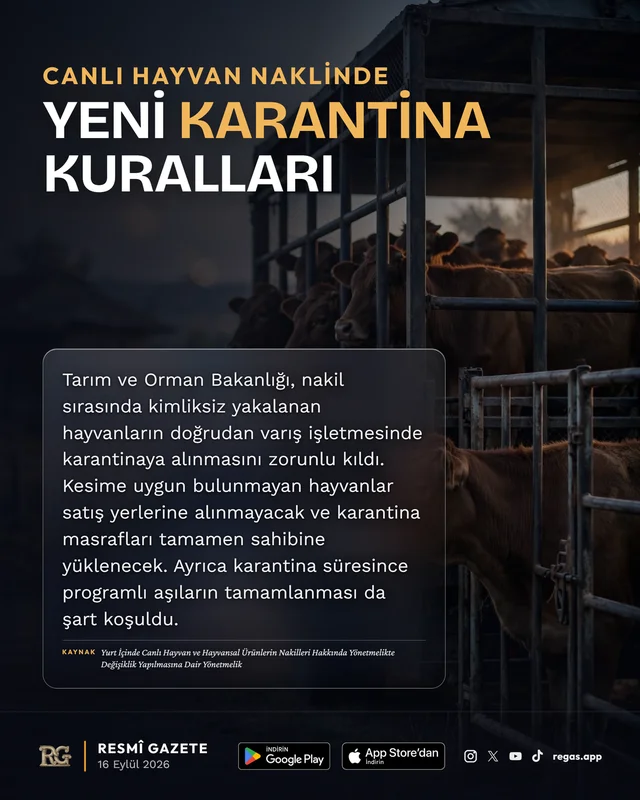
New Quarantine Rules for the Transport of Live Animals
Official titleRegulation on Amending the Regulation on the Transport of Live Animals and Animal Products Within the Country
The Ministry of Agriculture and Forestry has introduced new arrangements concerning animal transport and quarantine processes by making significant amendments to the Regulation on the Transport of Live Animals and Animal Products Within the Country.
Before
The second sentence of the sixth paragraph of Article 19 of the Regulation contained “(a).” The final sentences of the second and third paragraphs of Article 32, as well as the final sentence of the first paragraph and the entirety of the second paragraph of Article 33, were in force. The former regulation concerning unidentified animals caught during transport was different and did not stipulate a mandatory vaccination requirement during the quarantine period.
After
The reference in the second sentence of the sixth paragraph of Article 19 of the Regulation was changed to “(f).” A provision was introduced in Article 32 stating that animals found suitable for slaughter shall be slaughtered at the owner’s expense and that animals found unsuitable for slaughter shall be placed under quarantine and shall not be admitted to sales facilities. Article 33 was amended to provide that, if cattle and sheep and goats of unidentified status are caught during transport, they shall be dispatched to the destination establishment notified by their owner for quarantine, and that the scheduled vaccinations determined by the Ministry must be completed during the quarantine period. Certain sentences and the entirety of a paragraph in the relevant articles have been repealed.
Details of the Regulation
This regulation amends various articles of the Regulation on the Transport of Live Animals and Animal Products Within the Country, published in the Official Gazette dated 17/12/2011 and numbered 28145. In particular, new practices concerning slaughter and quarantine processes and unidentified animals attract attention.
First of all, the reference in the second sentence of the sixth paragraph of Article 19 of the Regulation has been changed from “(a)” to “(f).” This amendment is a technical adjustment to the relevant article.
Second, the amendments made to Article 32 provide that animals found suitable for slaughter by the official veterinarian shall be slaughtered without delay, with all expenses borne by their owner, and delivered to their owner. Animals found unsuitable for slaughter shall be placed under quarantine in accordance with the provisions of the third and fourth paragraphs of Article 33. It has also been stipulated that animals found unsuitable for slaughter shall not be admitted to animal sales facilities and shall be placed under quarantine. Certain final sentences in the former regulation have been repealed.
Finally, substantial amendments have been made to Article 33. The final sentence of the first paragraph and the entirety of the second paragraph have been repealed. The first sentence of the third paragraph has been reorganized to add a provision that, if cattle and sheep and goats of unidentified status are caught during transport, they shall be dispatched to the destination establishment notified by their owner and placed under quarantine. A new sentence added to this paragraph also makes it compulsory to complete the scheduled vaccinations determined by the Ministry during the quarantine period.
Questions You Might Have
- What happens if an unidentified bovine is caught during transport?
- Caught cattle and sheep and goats of unidentified status shall be dispatched to the destination establishment notified by their owner and placed under quarantine, and their scheduled vaccinations determined by the Ministry shall be completed during the quarantine period.
- What is the fate of animals found unsuitable for slaughter?
- Animals found unsuitable for slaughter by the official veterinarian shall not be admitted to animal sales facilities and shall be placed under quarantine in accordance with the provisions of the relevant regulation.
Key Terms
- Resmî veteriner hekim
- A competent veterinarian affiliated with or authorized by the Ministry of Agriculture and Forestry who conducts animal health and food safety inspections.
- Karantina
- A place or process in which animals are isolated from other animals or humans for a specified period and kept under observation and treatment for the purpose of preventing the spread of animal diseases.
- Tanımlattırılmamış hayvan
- An animal that has not been identified or registered by methods such as an ear tag or chip, in accordance with the regulations.
Affected Sectors
- Livestock farming
- Agriculture
- Animal transport
- Veterinary services
Where we posted this
Follow Turkish legal developments
REGAS analyzed all 31 items in the Official Gazette of 16 September 2026; we published only 7 of them here.
REGAS summarizes every change in the Turkish Official Gazette in plain language and notifies you.
The REGAS app is currently Turkish-only. If you would like English in the app, the best way to make it happen is to support the developer: get the app and just say so.


REGAS Commentary
These amendments aim to establish stricter control and monitoring mechanisms for the transport of live animals and animal products. In particular, the requirement that unidentified animals caught during transport be placed directly under quarantine and dispatched to the destination establishment may be regarded as an important step in terms of animal health and food safety. New obligations have been imposed on animal owners and carriers, and the costs of slaughter and quarantine processes shall be borne by the animal owner. Mandatory vaccinations to be administered during the quarantine period will also play a critical role in preventing the spread of animal diseases.