
Judicial Remedy Unavailable for Disciplinary Sanction in Tsk
Official titleConstitutional Court Decision dated 4/6/2026, E: 2025/212, K: 2026/127
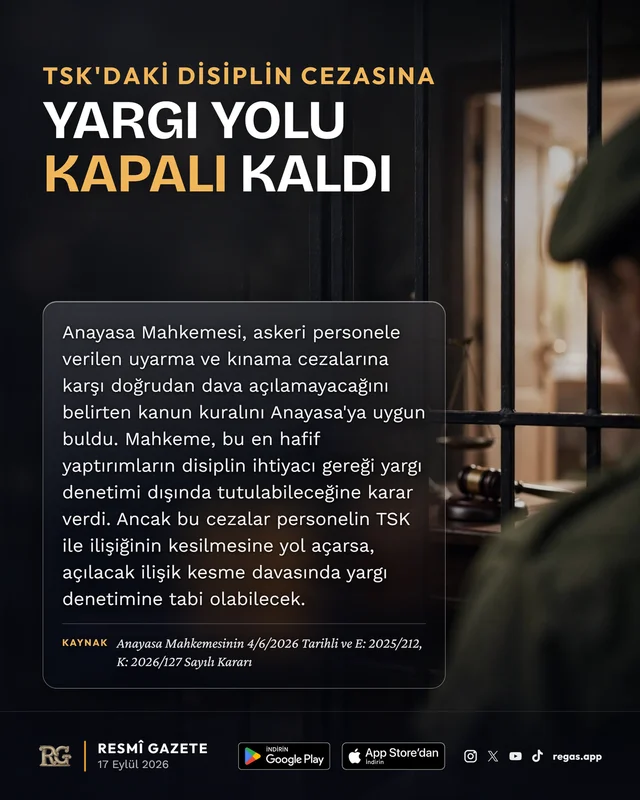
The Constitutional Court has ruled that the statutory provision barring direct judicial remedies against the warning and reprimand sanctions imposed on TSK personnel does not violate the constitution and has rejected the request for annulment.
Details of the Regulation
In the application filed by the Ankara 23rd Administrative Court, annulment was sought of the wording in Article 43 of the Turkish Armed Forces Disciplinary Act No. 6413 stating that no lawsuit may be brought against the warning and reprimand sanctions imposed on military personnel, including officers. The reasoning of the application asserted that this circumstance unduly restricted the freedom to seek legal remedy and the right of access to the court.
In its substantive review, the Court stated that the TSK’s specific disciplinary regime could differ from that applicable to civilian civil servants as necessitated by military service. The decision stated that warning and reprimand sanctions are the lightest sanctions within the hierarchy of disciplinary sanctions and that keeping these sanctions outside judicial review for the purpose of maintaining discipline falls within the legislative body’s discretionary authority.
However, the Court recalled that, following the legislative amendment made in 2024, these sanctions are also subject to judicial review in a severance-of-employment lawsuit when the personnel’s employment relationship with the TSK is terminated as a direct result of these sanctions. Having found that this mechanism strikes a fair balance between the freedom to seek legal remedy and the need for discipline, the Court ruled by majority vote that the rule does not violate the constitution.
Questions You Might Have
- Can an officer who receives a reprimand sanction directly file an action for annulment?
- No, under this decision, no direct lawsuit may be brought against warning and reprimand sanctions, which are the lightest disciplinary sanctions.
- Do these sanctions never go before a court?
- If the personnel’s employment relationship with the TSK is terminated because of these sanctions, the legality of the sanctions may be examined within the severance-of-employment lawsuit.
- Why was the decision not rendered unanimously?
- 6 members, including the President, filed a dissenting opinion, arguing that this rule violates the freedom to seek legal remedy and that even the lightest sanction must be subject to judicial review.
Key Terms
- İtiraz Yolu
- A claim that the statutory provision applied during the hearing of a lawsuit violates the constitution and referral of the matter to the Constitutional Court.
- Yargı Yolu Kapalı
- The circumstance in which certain administrative transactions cannot be brought before the courts for review.
- Ölçülülük İlkesi
- The requirement that a restriction imposed on fundamental rights be compatible with the purpose, necessary, and proportionate.
Where we posted this
Follow Turkish legal developments
REGAS analyzed all 47 items in the Official Gazette of 17 September 2026; we published only 6 of them here.
REGAS summarizes every change in the Turkish Official Gazette in plain language and notifies you.
The REGAS app is currently Turkish-only. If you would like English in the app, the best way to make it happen is to support the developer: get the app and just say so.


REGAS Commentary
This decision has once again confirmed that military discipline is subject to stricter scrutiny than the civilian bureaucracy. Sanctions regarded as the “lightest” for military personnel cannot be individually brought before a court; however, if these sanctions accumulate and result in the person’s removal from the profession (severance of employment), a judicial remedy may be available. The dissenting opinions of President Kadir Özkaya and 5 members demonstrate that there was strong opposition within the Court to the restriction of the freedom to seek legal remedy even at this point.