
Authorization for Gmo Production That Does Not Permit Sales
Official titleDecision No. 42 of the Biosafety Board
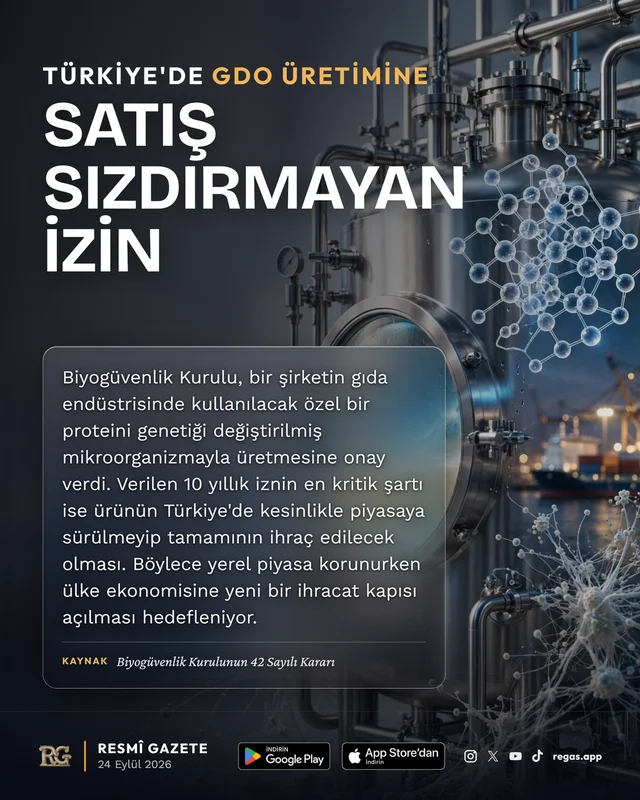
The Biosafety Board authorized Livzym Biyoteknoloji Araştırma Geliştirme San. ve Tic. A.Ş. to produce the “beta-lactoglobulin” protein using genetically modified Aspergillus oryzae LIVZ-114 for ten years, provided that the specified strict conditions are complied with and the entire product is exported.
Details of the Regulation
Following its assessment, the Biosafety Board approved the export-registered production by Livzym Biyoteknoloji A.Ş. of the “beta-lactoglobulin” protein for use in the food industry. This production shall be carried out using the Aspergillus oryzae LIVZ-114 microorganism, whose capacity has been enhanced through modern biotechnological methods. The decision was taken in accordance with the reports of the Scientific Risk Assessment Committee and the Socio-Economic Assessment Committee. The approval shall be valid for ten years on the basis of the relevant provisions of the Biosafety Act. The approval is conditional upon the entire production being exported, and the product shall not be placed on the market in Türkiye. The purpose of the decision is export-oriented production of the relevant protein for use in the food industry. The code “LIVZ-114” shall be used as the product’s distinctive identity.
Questions You Might Have
- Can the beta-lactoglobulin protein to be produced under this decision be consumed in Türkiye?
- No. As expressly stated in the decision, the entire amount of the product to be produced is required to be exported. Therefore, it shall not be offered for consumption as food in Türkiye.
- For how long may Livzym Biyoteknoloji A.Ş. use this authorization?
- The production authorization granted by the Biosafety Board shall be valid for ten years from the date on which the decision is published.
- What controls will the production process be subject to?
- The company is required to submit its Risk Management Plans and annual reports to the Ministry and to communicate its safety and emergency precautionary measures plan. Production, labeling, transportation, waste management, and monitoring processes shall also be subject to strict inspection in accordance with the relevant statutes and regulations.
Key Terms
- Biyogüvenlik Kanunu
- A fundamental statute enacted to regulate activities involving genetically modified organisms and their products, for the purpose of protecting human, animal, and plant health and the environment.
- Genetik Yapısı Değiştirilmiş Organizmalar (GDO)
- Living organisms whose genetic material has been modified in a laboratory environment using modern biotechnological methods.
- Beta-laktoglobulin
- A type of protein found especially in milk and dairy products that may cause certain food allergies but may also be used in the food industry for various purposes.
- İhraç Kayıtlı Üretim
- A production or sales authorization granted on condition that the entire amount of the manufactured product is sold abroad. This is generally used to overcome specific restrictions in the local market or to benefit from special incentives.
Where we posted this
Follow Turkish legal developments
REGAS analyzed all 47 items in the Official Gazette of 24 September 2026; we published only 3 of them here.
REGAS summarizes every change in the Turkish Official Gazette in plain language and notifies you.
The REGAS app is currently Turkish-only. If you would like English in the app, the best way to make it happen is to support the developer: get the app and just say so.


REGAS Commentary
This decision is an important step demonstrating Türkiye’s expertise and production capacity in the field of biotechnology and genetic engineering. By requiring the entire product to be exported in order to address concerns regarding the use of genetically modified organisms (GMOs) in the food industry, the decision places local consumer safety first. While opening a new export channel for the company, it also offers the national economy the potential to generate foreign currency income. At the same time, the introduction of strict inspection and reporting requirements at every stage of the process, from production to waste management, aims to establish a safe production environment by minimizing potential risks.