
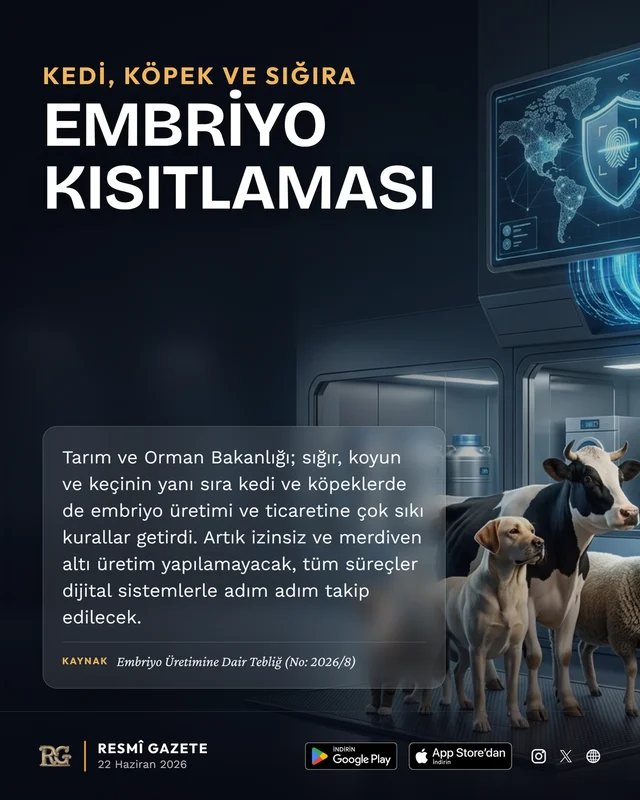
Restrictions on Embryos for Cats, Dogs, and Cattle
Official titleCommuniqué on Embryo Production (No: 2026/8)
It is a communiqué of the Ministry of Agriculture and Forestry regulating the procedures and principles regarding the production, transfer, storage, placing on the market, and traceability of embryos from breeding cattle (including water buffaloes), sheep, goats, cats, and dogs.
Before
The absence of a single integrated legislation covering comprehensive and biotechnological developments, including cats and dogs in embryo production.
After
Bringing all production and transfer processes into compliance with IETS standards, establishing standards for mobile production vehicles, and making a 30-day quarantine waiting period mandatory.
Details of the Regulation
With this Communiqué, strict technical, hygienic, and administrative rules have been introduced for embryo production processes in order to increase efficiency in animal production and ensure the creation of herds with high genetic capacity. Within the scope of the Communiqué, minimum age limits have been set for cattle, water buffalo, sheep, goat, cat, and dog species to be used as donors. For example, in in vivo production, cattle must be at least 13 months old, water buffaloes at least 18 months old, sheep and goats at least 8 months old, and cats and dogs at least 6 months old.
All establishments where embryos will be produced are required to be authorized by the Ministry and hold the status of 'disease-free establishment'. Donor animals must be tested for critical animal diseases such as tuberculosis, brucellosis, enzootic bovine leukosis (EBL), and bluetongue, and all of these tests must yield negative results. Furthermore, frozen embryos are required to be kept in storage tanks for at least 30 days (quarantine period) before being placed on the market, in order to monitor possible latent diseases in the donor animal.
All produced embryos must be labeled and straw-packaged in accordance with International Embryo Technology Society (IETS) standards, and registered in national recording systems such as TÜRKVET/PETVET. Minimum internal volume and technical equipment standards have also been set for mobile embryo production vehicles; the activities of establishments that do not comply with these standards or produce without authorization will be suspended, and non-compliant embryos will be destroyed.
Questions You Might Have
- Can an ordinary farmer produce embryos from their own cow and sell them to their neighbor?
- No. Embryo production and sale can only be carried out by embryo production centers and production and sales establishments authorized by the Ministry with 'disease-free' status. Establishments wishing to transfer to their own animals are also required to obtain donor authorization.
- Can eggs be collected from a quality animal slaughtered at a slaughterhouse to produce embryos?
- No, pursuant to the Communiqué, animals slaughtered in slaughterhouses can strictly not be used as oocyte (egg) or embryo donors.
- How long after being produced can an embryo be transferred to another animal?
- Freshly produced embryos must be transferred within 2 days at the latest. As for frozen embryos, their transfer is allowed after being kept in storage for at least 30 days to finalize whether any disease has emerged in the donor animal.
Key Terms
- İn vivo embriyo üretimi
- The method in which multiple ovulation is provided through hormone therapy applied to the female donor animal, and these eggs are collected by flushing after being fertilized in the mother's body via artificial insemination.
- İn vitro embriyo üretimi
- The method in which eggs (oocytes) collected from a female donor animal are artificially fertilized in a laboratory environment, and the development process is initiated in the laboratory.
- Hastalıktan ari işletme
- A livestock establishment designated by the Ministry and officially certified as free from contagious animal diseases.
- IETS
- The International Embryo Technology Society, which sets global standards in embryo transfer and production technologies.
Affected Sectors
- Cattle and sheep farming
- Veterinary services
- Biotechnology and laboratories
- Pet breeding
Where we posted this
Follow Turkish legal developments
REGAS analyzed all 23 items in the Official Gazette of 22 June 2026; we published only 2 of them here.
REGAS summarizes every change in the Turkish Official Gazette in plain language and notifies you.
The REGAS app is currently Turkish-only. If you would like English in the app, the best way to make it happen is to support the developer: get the app and just say so.


REGAS Commentary
Disciplining the use of biotechnological methods in the livestock sector, this regulation will, in the long term, facilitate Türkiye's meeting of its need for high-quality breeding stock through domestic means. Particularly by transferring embryos obtained from elite herds to surrogate mothers, whereas normally only one offspring per year can be obtained from an animal, a large number of superior quality offspring can be obtained thanks to embryo transfer. Bringing standards to embryo production in cats and dogs as well is an important step in preventing underground breeding and protecting pure breeds.