
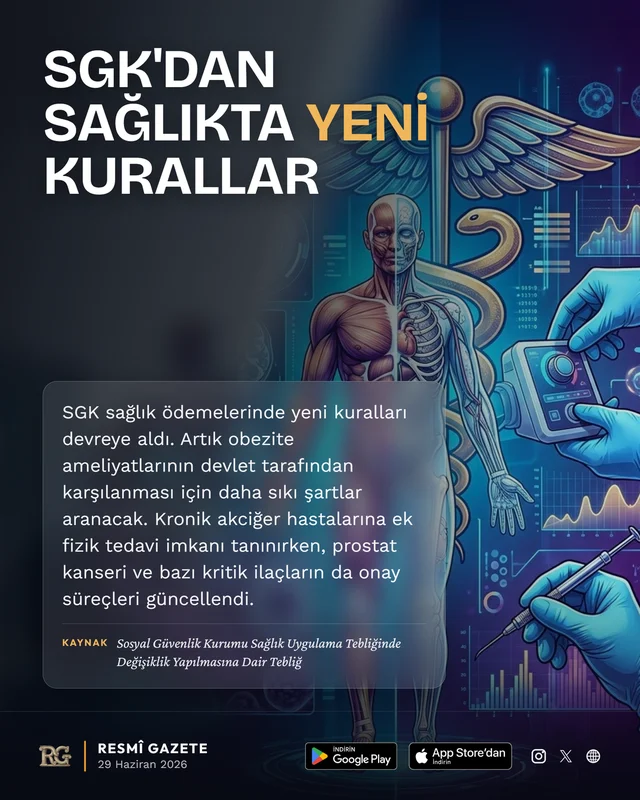
New Health Rules from the SGK
Official titleCommuniqué Amending the Social Security Institution Health Implementation Communiqué
These amendments to the Social Security Institution Health Implementation Communiqué update the billing and utilization conditions for various healthcare services such as physical therapy, bariatric surgery, and prostate adenocarcinoma, while clarifying the reimbursement criteria for certain drugs like Ravulizumab and making technical updates to the reimbursement lists.
Before
More general session and reporting rules in physical therapy and rehabilitation practices; less restrictive payment conditions for obesity surgery; less detailed defined reimbursement scope for pulmonary rehabilitation; absence or difference of detailed criteria regarding some advanced prostate cancer treatments and the use of the drug Ravulizumab; different procedures in the billing of home health dental treatments and wound care products.
After
Outpatient TRSM, ÇÖZGEM, and Outpatient Rehabilitation Center services will be billed via ANNEX-2/C, and home health dental treatments via ANNEX-2/Ç. Physical therapy session and reporting conditions (especially an additional 30 sessions possibility for the respiratory system) and health board conditions were detailed. For obesity surgery, conditions such as BMI, multidisciplinary health board, 6-month conservative treatment trial, and facility/surgeon competency were introduced. Reimbursement criteria were determined for Lu-177 and Actinium-225 PSMA compounds in the treatment of prostate adenocarcinoma in tertiary healthcare institutions, with specific clinical conditions and prior treatment unresponsiveness. Pulmonary rehabilitation services will be covered with detailed indications, reporting, and session limits, and a daily physician patient limit was introduced. Detailed clinical, laboratory, and pre-treatment criteria were defined for the drug Ravulizumab in the treatment of PNH and NMOSB. The cost of nusinersen/risdiplam will not be covered after gene replacement therapy. Prescription conditions for some drugs were updated. Technical updates were made to various medical supply and service point lists.
Details of the Regulation
The Communiqué introduces comprehensive amendments to the Social Security Institution Health Implementation Communiqué (SUT). Article 1 ensures that the billing of outpatient treatment services for certain centers (TRSM, ÇÖZGEM, Outpatient Rehabilitation Center) is conducted through the SUT Annex ANNEX-2/C list, and the billing procedure for dental treatments within the scope of home healthcare services is designated according to the ANNEX-2/Ç list. Article 2 details session limits and reporting conditions for physical therapy and rehabilitation applications, specifying that additional sessions are possible with a medical board report, particularly for respiratory system disorders. Article 3 significantly tightens the reimbursement conditions for bariatric surgery treatments. For individuals with a Body Mass Index (BMI) >40 or a BMI of 35-40 with comorbidities, a multidisciplinary medical board report and a requirement of failure in lifestyle modification/medical treatment for at least 6 months are mandated. Furthermore, Ministry of Health-approved documentation and qualifications will be required for the surgeon performing the procedure and for the facility. Article 4 establishes the usage criteria for Lu-177 and Actinium-225 PSMA compounds in the treatment of prostate adenocarcinoma, emphasizing that these advanced treatments can only be utilized by tertiary healthcare providers, under specific clinical and laboratory conditions, and in cases of unresponsiveness to prior treatments. Article 5 clarifies under which circumstances pulmonary rehabilitation will be covered by the Institution, setting out reporting and session limits, and defines the billing method for other services in inpatient applications along with the daily patient limit per physician. Article 6 regulates in detail the reimbursement conditions of the drug named Ravulizumab in the treatment of Paroxysmal Nocturnal Hemoglobinuria (PNH) and Neuromyelitis Optica Spectrum Disorder (NMOSB), establishing conditions such as special clinical criteria, prior treatment responses, and Ministry of Health approval. Article 7 stipulates that the costs of nusinersen or risdiplam following a one-time gene replacement therapy will not be covered by the Institution. Article 8 updates the reporting and prescribing conditions for certain pharmaceuticals (related to allopurinol), clarifying scenarios that may require approval from multiple specialists. Finally, Articles 9, 10, 11, 12, 13, 14, 15, 16, and 17 standardize the payment system by performing technical updates and price/code changes across various service and material lists in the SUT annexes.
Questions You Might Have
- What does this communiqué mean for a citizen who wants to undergo bariatric surgery?
- Having a high weight alone is no longer sufficient for SGK coverage. Depending on specific BMI values, you will need to be approved by a multidisciplinary medical board, your comorbid conditions (if any) must be evaluated, and you must have tried conservative methods such as lifestyle modifications or medical therapy for at least 6 months. Additionally, the surgeon who will perform the operation and the hospital are required to hold specific certifications.
- I am a chronic lung patient and I previously received physical therapy. Does this communiqué offer me the possibility of additional sessions?
- Yes, if you have specific respiratory system diseases such as chronic pulmonary insufficiency and physicians provide medical justification, you may have the opportunity to receive an additional 30 sessions of pulmonary rehabilitation per year with a medical board report. However, this does not apply to post-surgical diagnoses.
- Has there been any change in billing for someone receiving dental treatment services at home?
- Yes, the costs of dental treatments provided within the scope of home healthcare services will now be billed directly through the SUT Annex ANNEX-2/Ç list. This clarifies the billing process.
- Will everyone have access to advanced treatments like Lu-177 or Actinium-225 used in prostate cancer treatment?
- These advanced treatments will be covered only by tertiary official healthcare providers and under very strict criteria. The patient must have a diagnosis of progressive, castration-resistant metastatic prostate cancer, must not have responded to prior standard treatments, must meet specific clinical and imaging criteria, and must be approved by a multidisciplinary medical board report.
Key Terms
- SUT (Sağlık Uygulama Tebliği)
- A regulation published by the Social Security Institution that determines the procedures and principles regarding the delivery and billing of healthcare services.
- TRSM (Toplum Ruh Sağlığı Merkezi)
- Centers providing rehabilitation and follow-up services in the community for patients with severe mental disorders.
- ÇÖZGEM (Çok Disiplinli Çocuk ve Genç Ruh Sağlığı Merkezi)
- Centers delivering services for the mental health problems of children and youth through a multidisciplinary approach.
- Pulmoner Rehabilitasyon
- A holistic treatment program aiming to improve the physical functions and quality of life of patients with lung diseases.
- Obezite Cerrahisi
- Surgical interventions performed to achieve weight loss in severely overweight individuals (Bariatric Surgery).
- Prostat Adenokarsinomu
- A type of cancer of the prostate gland.
- Lu-177 İşaretli PSMA Bileşikleri
- Radiopharmaceuticals labeled with the lutetium-177 isotope, used in the treatment of prostate cancer.
- Actinyum-225 İşaretli PSMA Bileşikleri
- Radiopharmaceuticals labeled with the actinium-225 isotope, used in the treatment of prostate cancer.
- Ravulizumab
- A drug used in the treatment of rare diseases such as Paroxysmal Nocturnal Hemoglobinuria (PNH) and Neuromyelitis Optica Spectrum Disorder (NMOSB).
- BMI (Vücut Kitle İndeksi)
- A value obtained by dividing a person's weight by the square of their height, indicating the degree of obesity.
- EDSS (Expanded Disability Status Scale)
- A scale used to measure the degree of disability in neurological diseases such as Neuromyelitis Optica Spectrum Disorder (NMOSB).
Affected Sectors
- Healthcare providers
- Physical therapy and rehabilitation centers
- Bariatric surgery centers
- Oncology centers
- Pulmonology specialists
- Hematology specialists
- Neurology specialists
- Patients and their families
- Pharmaceutical companies
- Medical device manufacturers
Where we posted this
Follow Turkish legal developments
REGAS analyzed all 20 items in the Official Gazette of 29 June 2026; we published only 1 of them here.
REGAS summarizes every change in the Turkish Official Gazette in plain language and notifies you.
The REGAS app is currently Turkish-only. If you would like English in the app, the best way to make it happen is to support the developer: get the app and just say so.


REGAS Commentary
This communiqué directly impacts access to high-cost and significant healthcare services, particularly bariatric surgery and advanced prostate cancer treatment. The stricter rules introduced for bariatric surgery require patients to be evaluated through a multidisciplinary approach and to attempt conservative treatment methods, thereby ensuring that surgical decisions rest on sounder foundations. However, this situation may make access to surgery more difficult or prolonged for some patients. The expansion of the scope of pulmonary rehabilitation, on the other hand, presents significant potential for improvement for patients with chronic respiratory conditions. Clarifying the usage criteria for expensive drugs like Ravulizumab aims both to help patients reach the correct treatment and to ensure the efficient use of public resources. Overall, the communiqué intends to make healthcare expenditures more rational and to enhance service quality, although it may increase bureaucratic processes in certain areas.