
Partial Action Decision from the Constitutional Court
Official titleDecision of the Constitutional Court Dated 16/4/2026 and Numbered E: 2025/231, K: 2026/82
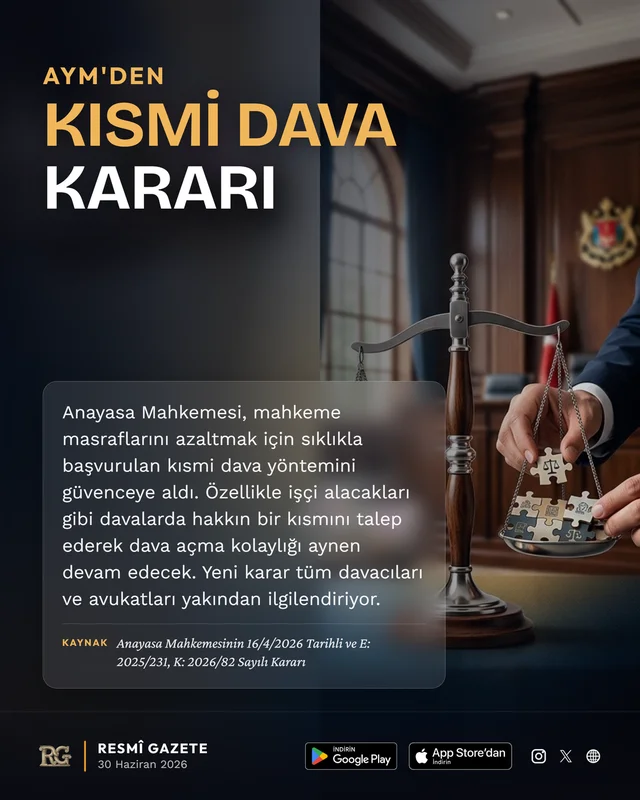
The Constitutional Court decided that the partial action regulation in Article 109 of the Code of Civil Procedure (HMK) is not unconstitutional, dismissing the objection regarding the article heading on the grounds that it lacks normative character, and rejecting the objection directed at the paragraphs.
Details of the Regulation
The Ankara 73rd Labor Court, in a lawsuit for the collection of employment claims, applied to the Constitutional Court by way of objection, claiming that the title of Article 109 of the Code of Civil Procedure No. 6100, its paragraph (1), and the phrase "...partial..." in paragraph (3) were contrary to Articles 2, 5, 10, 13, 35, 36, 40, and 141 of the Constitution. The applicant Court argued that the partial action has certain disadvantages compared to the unliquidated claim action, may restrict the right of access to court, and may prolong proceedings.
In its review, the Constitutional Court did not examine the objection regarding the title of Article 109 of the HMK, on the grounds that article titles do not in themselves express a judicial judgment and do not possess the quality of a reviewable norm. Regarding this section, it ruled that 'there is no room for a decision'.
Evaluating the objection aimed at paragraph (1) of Article 109 of the HMK and the phrase "...partial..." in paragraph (3), the Constitutional Court decided that these rules are not contrary to Articles 2 (state governed by the rule of law), 36 (freedom to claim rights and right to a fair trial), 141 (concluding trials at the least possible expense and with swiftness), and 142 (the establishment, duties and powers, functioning, and trial procedures of courts are regulated by law) of the Constitution. The Court stated that the opportunity to bring a partial action enables individuals to benefit more easily from the freedom to claim rights, reduces the risk of litigation costs, and serves the public interest. Therefore, the objection was rejected UNANIMOUSLY.
Questions You Might Have
- Which parts of Article 109 of the HMK did the Constitutional Court find unconstitutional?
- The Constitutional Court did not find any part of Article 109 of the HMK unconstitutional. It did not examine the objection regarding the article title and rejected the objection directed at paragraphs (1) and (3).
- Why was the title of Article 109 of the HMK not examined by the Constitutional Court?
- The Constitutional Court excluded it from examination on the grounds that article titles do not in themselves express a judicial judgment and are not normative in nature, thus not considered a reviewable rule of law.
- What does this decision mean in terms of employment claim lawsuits?
- This decision confirms that the practice of claiming receivables such as employment claims through partial actions is in accordance with the Constitution. Plaintiffs will continue to be able to make only a portion of their claims the subject of a lawsuit in order to reduce the risk of litigation costs.
Key Terms
- Kısmi Dava
- In cases where the subject matter of the claim is divisible by its nature, the assertion of only a portion of the claimed receivable or right by way of litigation.
- İtiraz Yolu
- The procedure whereby a court trying a case, upon finding a provision of law it is to apply unconstitutional, applies to the Constitutional Court requesting the annulment of that provision.
- Eda Davası
- The type of action in which it is requested that the defendant be sentenced to give, do, or refrain from doing something, and the performance of an obligation is demanded.
- Yargılama Giderleri
- The general name for expenses incurred during the litigation process, such as court fees, notification costs, discovery expenses, expert witness fees, and attorney fees.
- Usul Ekonomisi İlkesi
- The principle expressing that judicial proceedings must be concluded at the least expense and with the greatest possible speed.
Where we posted this
Follow Turkish legal developments
REGAS analyzed all 34 items in the Official Gazette of 30 June 2026; we published only 2 of them here.
REGAS summarizes every change in the Turkish Official Gazette in plain language and notifies you.
The REGAS app is currently Turkish-only. If you would like English in the app, the best way to make it happen is to support the developer: get the app and just say so.


REGAS Commentary
This decision confirmed the constitutionality of the partial action method, which is frequently resorted to in legal proceedings. For citizens and lawyers, especially in cases of unliquidated claims such as employment claims, it means that the existing legal framework will continue regarding litigation strategies. While preserving the advantages offered by the partial action (such as reducing the risk of high litigation costs), lawsuits must be filed taking into account potential disadvantages (such as statute of limitations and interest issues) as well. Although the decision does not eliminate uncertainties in trial processes, it has reinforced the constitutional foundation of the existing system.