
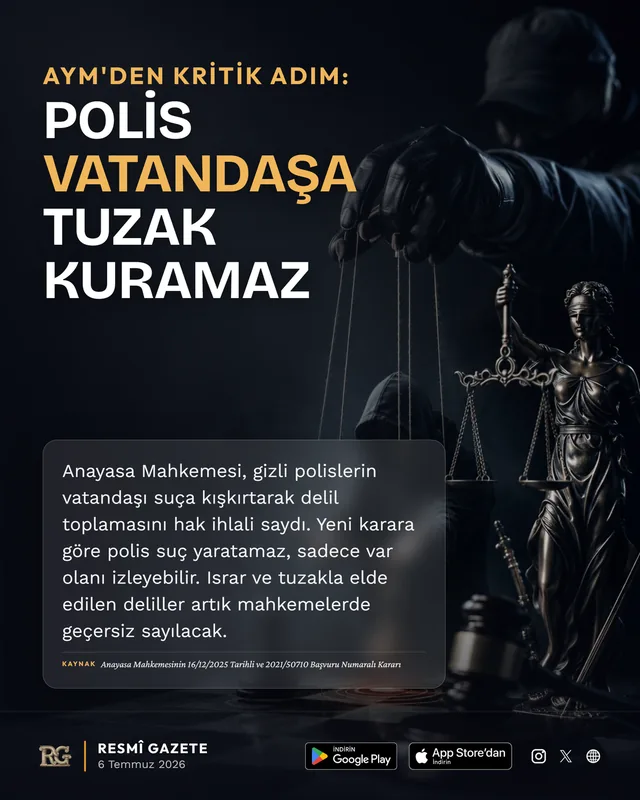
Critical Step from AYM: Police Cannot Set a Trap for Citizens
Official titleDecision of the Constitutional Court Dated 16/12/2025 and Bearing Application Number 2021/50710
The Constitutional Court decided that the conviction verdict rendered on the basis of evidence obtained as a result of law enforcement officers (police) inciting the person to commit a crime in the guise of a customer (agent provocateur) violated the right to a fair trial.
Details of the Regulation
The application was made on the claim that a citizen tried in Ankara on charges of pandering was encouraged to commit a crime by police officers acting like customers, and was convicted with unlawful evidence obtained in this manner. According to court records, police officers called the applicant by phone asking them to procure women for prostitution, and although the applicant initially refused, upon persistent demands, directed the women to the hotel designated by the police. The local court accepted this process as caught red-handed and rendered a conviction verdict, but AYM evaluated this situation from a different legal perspective.
The Plenary of the Constitutional Court, applying the criteria of the 'Material Test' and the 'Procedural Safeguards Test', determined that law enforcement, while required to remain passive during the investigation, assumed an active role and directed the person to commit a crime. In the decision, it was emphasized that there was no prior concrete evidence indicating that the applicant would have committed this crime without the intervention of law enforcement, and that the police displayed an inciting attitude. It was stated that this situation vitiated the defendant's free will and rendered the trial 'unfair' from the very beginning.
Consequently, the Court decided by a majority of votes that the right to a fair hearing regulated under Article 36 of the Constitution was violated. Pursuant to the decision, to eliminate the consequences of the violation, the file was sent to the Ankara 2nd Criminal Court of First Instance to conduct a retrial. However, the applicant's claim for compensation was rejected on the grounds that the decision for a retrial constituted sufficient redress.
Questions You Might Have
- Can't the police disguise as a customer to catch the offender?
- They can, but they must remain passive. They can only monitor a person who already has the intent to commit a crime; if they convince and direct someone with no intention of committing a crime toward a crime, this constitutes a violation.
- Will the applicant receive compensation after this decision?
- No, the court deemed the violation decision and the opening of the path for a retrial sufficient, rejecting the request for monetary compensation.
- Does this decision mean the applicant is definitively acquitted?
- No, it has only been ruled that the previous trial was unfair. The file goes to the local court and is reheard taking into account non-incitement evidence as well.
Key Terms
- Ajan Provokatör
- An undercover agent who incites a person to commit a crime, offers them an opportunity to commit a crime, or induces an intent to commit a crime in them.
- Maddi Test
- The examination of the extent to which the intervention of law enforcement was decisive in the commission of the crime (whether passive or active).
- Hakkaniyete Uygun Yargılanma
- The principle that the case is conducted in a fair, equal, and honest manner for both parties.
- Usul Güvenceleri Testi
- The review of whether the court examined the incitement claims with sufficient depth during the trial stage.
Where we posted this
Follow Turkish legal developments
REGAS analyzed all 19 items in the Official Gazette of 6 July 2026; we published only 3 of them here.
REGAS summarizes every change in the Turkish Official Gazette in plain language and notifies you.
The REGAS app is currently Turkish-only. If you would like English in the app, the best way to make it happen is to support the developer: get the app and just say so.


REGAS Commentary
This decision draws a very sharp line for the 'undercover investigation' methods of security units. Law enforcement agencies may assume an undercover identity to prevent or prove a crime; however, they can never 'create a crime'. If a police officer directs someone who has no intention of committing a crime to a crime by convincing or persisting, all evidence obtained through this path is considered 'fruit of the poisonous tree' and must be rejected by the courts. In terms of citizens, this decision is a strong rule of law guarantee reminding the state of its obligation not to encourage individuals to commit crimes.