
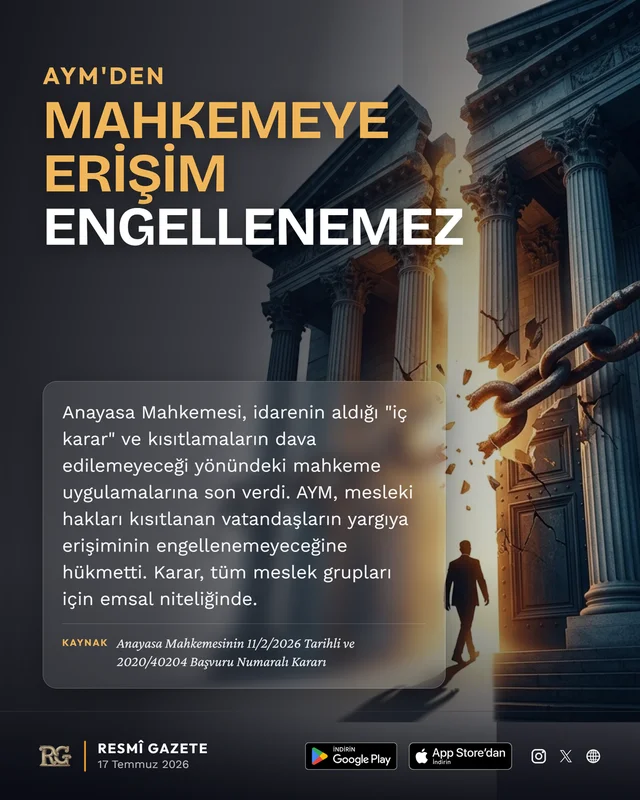
From the Constitutional Court: Access to Court Cannot Be Restricted
Official titleDecision of the Constitutional Court Dated 11/2/2026 and Application Number 2020/40204
The Constitutional Court evaluated the individual application filed by a sworn-in certified public accountant against the administrative court's decision of 'rejection without examination on the merits' regarding a lawsuit he filed due to the implementation of an occupational restriction, and ruled that the right of access to a court had been violated.
Details of the Regulation
The applicant learned that he was included in the list of 'restricted sworn-in certified public accountants' by the Ministry of Treasury and Finance without any notification, and as a result, his professional activities were restricted. Upon the implicit rejection of his application requesting the lifting of this practice and the compensation of his damages, he filed a lawsuit before the Ankara 17th Administrative Court. However, the Administrative Court decided to reject the case without examination on the merits, on the grounds that the transaction in question was an 'internal correspondence' and 'not of the nature of a final and enforceable act'. The applicant's appeal was also rejected by the Ankara Regional Administrative Court and the decision was upheld. Thereupon, the applicant applied to the Constitutional Court, claiming that his right of access to a court within the scope of the right to a fair trial had been violated.
The Constitutional Court determined that the administrative court's narrow interpretation of the definition of 'final and enforceable act' prevented the applicant's access to the judicial process and that this situation constituted an interference with the right of access to a court guaranteed in Article 36 of the Constitution. The Court decided that although the interference had a legal basis and served a legitimate aim such as procedural economy, this interference was disproportionate, considering that the restriction applied in the concrete case produced legal consequences and directly affected the rights and interests of the applicant. In particular, it was emphasized whether a legal basis existed for such a practice by the administration or whether the authority of the administration had been discussed in judicial decisions.
For this reason, the Constitutional Court decided that the right of access to a court was violated and sent the file to the Ankara 17th Administrative Court for a retrial in order to eliminate the consequences of this violation. Furthermore, it was ruled that 40,446.90 TL in litigation expenses be paid to the applicant.
Questions You Might Have
- How can an administrative act qualified as an 'internal correspondence' cause a rights violation?
- Because the internal correspondence mentioned in the text resulted in the Sworn-in Certified Public Accountant being listed as 'restricted' and his professional activities being de facto restricted, it violated the right of access to a court in terms of its legal consequences.
- What does the Constitutional Court decision mean for other professionals in a similar situation?
- This decision shows that for other professionals exercising their professions, the path to seeking remedies against administrative acts being rendered exempt from judicial review by being qualified as 'internal correspondence' is open, and their right of access to a court is guaranteed.
- What is the Ankara 17th Administrative Court obliged to do now?
- The Ankara 17th Administrative Court is obliged to render a new decision by conducting a retrial in accordance with the principles and reasoning specified in the Constitutional Court's violation decision, eliminating the causes of the rights violation.
- Is there a legal basis for such restrictions applied to Sworn-in Certified Public Accountants?
- The Constitutional Court stated that the legal grounds for the administration's practice of 'inclusion in the list of restricted sworn-in certified public accountants' could not be established, and whether the administration was authorized regarding this transaction was not discussed in judicial decisions.
Key Terms
- Bireysel Başvuru
- It is an application remedy made to the Constitutional Court on the claim that one of the fundamental rights and freedoms guaranteed in the Constitution has been violated by public power.
- Mahkemeye Erişim Hakkı
- It is the right of everyone to bring a dispute before a court and to demand that the dispute be resolved effectively.
- İdarenin Kesin ve Yürütülebilir İşlemi
- These are administrative decisions that can be the subject of an administrative lawsuit, produce direct legal consequences in the legal order, do not require the approval of another authority, and cause a change in the legal status of the person concerned. Preparatory acts do not possess this character.
- Ölçülülük İlkesi
- It is the constitutional principle expressing that interferences with fundamental rights and freedoms must be suitable, necessary, and proportionate to achieve the intended goal.
- Zımni Red
- It is the situation where the administration fails to respond to an application within the statutory period, thereby being deemed to have implicitly rejected the application request.
Where we posted this
Follow Turkish legal developments
REGAS analyzed all 60 items in the Official Gazette of 17 July 2026; we published only 3 of them here.
REGAS summarizes every change in the Turkish Official Gazette in plain language and notifies you.
The REGAS app is currently Turkish-only. If you would like English in the app, the best way to make it happen is to support the developer: get the app and just say so.


REGAS Commentary
This decision sets an important precedent in terms of judicial review of administrative acts. In particular, it shows that restrictions suffered by citizens exercising their professions at the hands of the administration which produce legal consequences cannot be excluded from judicial review by being deemed 'internal acts'. For certain occupational groups such as financial advisors, it means that their right of access to justice is guaranteed in cases where administrative decisions directly affect their professional activities. This decision strengthens the freedom of individuals to seek remedies against arbitrary practices of the administration and serves as a ray of hope for other members of professions in similar situations. It reminds administrative courts once again that when evaluating the nature of an administrative act, they must not ignore its real effects on the individual.