
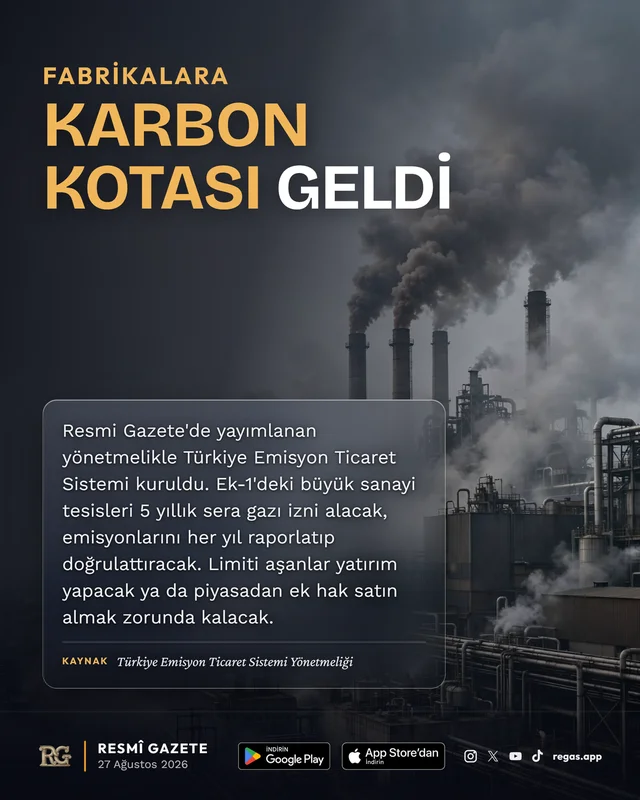
Carbon Allowances Have Arrived at Factories
Official titleTürkiye Emission Trading System Regulation
This Regulation sets out the comprehensive procedures and principles governing the establishment of the Türkiye Emission Trading System (TR ETS), the monitoring, reporting and verification of greenhouse gas emissions, and allowance trading. The previously adopted Regulation on Monitoring of Greenhouse Gas Emissions has been repealed and replaced with a new market-based mechanism that incentivizes emissions reductions.
Before
The Regulation on Monitoring of Greenhouse Gas Emissions, published in Official Gazette No. 29003 dated 17/5/2014, has been repealed. Although that Regulation focused solely on the monitoring of emissions, the new system also includes emissions trading.
After
The Türkiye Emission Trading System (TR ETS) has been established. In addition to the monitoring, reporting and verification of greenhouse gas emissions, this system requires installations to obtain an emissions permit, trade through emissions allowances, and fulfil emissions reduction obligations within a specified cap. New tools have been introduced, including market stability and flexibility mechanisms and the use of an additional reserve.
Details of the Regulation
The Türkiye Emission Trading System (TR ETS) Regulation standardizes the processes for monitoring, reporting and verifying greenhouse gas emissions and imposes obligations on installations within the scope of the emissions trading system. The Regulation covers Category B and Category C installations carrying out the activities specified in Annex 1, while excluding research and development activities, installations using biomass, and military elements. Installations included in the system must obtain a greenhouse gas emissions permit, which is valid for five years and must be renewed. The permit application process, assessment procedure and cancellation conditions are explained in detail. Applications are to be submitted electronically.
The Regulation also determines the procedures for exporting, offering and distributing allowances. Free allowances will be distributed using a benchmarking method on the basis of sub-installations. The Carbon Market Board has the authority to determine the benchmark value, sectoral activity coefficient and free allowance ratio. The allowance surrender obligations of installations and the sanctions to be applied where these obligations are not fulfilled have been clarified. In addition, a market stability mechanism, flexibility mechanisms such as banking and borrowing, and a complementary allowance pricing mechanism have also been introduced to ensure market stability.
Detailed principles and obligations have been established for the monitoring, reporting and verification of greenhouse gas emissions. Installations are required to prepare monitoring plans, submit annual emissions reports to the Presidency on time, and have these reports verified by accredited verification bodies. The Regulation has been prepared on the basis of Climate Statute No. 7552 and has also categorized administrative fines and the sanctions to be applied in cases of non-compliance according to the amount of greenhouse gas emissions. Transitional provisions regulate matters such as the pilot implementation period, transitional procedures for obtaining a greenhouse gas emissions permit, and submission deadlines for the Monitoring Methodology Plan.
Questions You Might Have
- Which installations within the scope of TR ETS are required to obtain a greenhouse gas emissions permit, and what is the validity period of this permit?
- Category B and Category C installations carrying out the activities listed in Annex 1 to the Regulation are required to obtain a greenhouse gas emissions permit. This permit is valid for five years from the date of entry into force.
- Are there any special cases or installations excluded from the scope of the Emission Trading System (ETS)?
- Yes, installations or parts of installations conducting research and development activities, installations or parts of installations solely using biomass, military elements, and facilities belonging to schools, universities, hospitals and defense industry organizations are excluded from the scope of ETS. In addition, natural gas and crude oil transmission and storage activities are exceptions until the end of the first implementation period.
- What is the most critical issue that installations should consider during their emissions reporting and verification processes?
- Installations must report their emissions and activity levels for the preceding year by 30 April each year. Before these reports are submitted to the Presidency, they must be verified by accredited verification bodies appointed by MEDAS. Serious administrative sanctions will be imposed where incorrect or misleading information is submitted.
- What sanctions are imposed on installations that fail to fulfil their allowance surrender obligations?
- Administrative fines provided for in Statute No. 7552 are imposed on installations that fail to fulfil their allowance surrender obligations. In addition, the quantity of allowances not surrendered is added to the following year’s obligation and must be compensated.
Key Terms
- Emisyon Ticaret Sistemi (ETS)
- A market-based national or international mechanism that encourages emissions reductions by setting an upper limit on greenhouse gas emissions and enabling allowances to be purchased and sold.
- Tahsisat
- It denotes a greenhouse gas emission right equivalent to one tonne of carbon dioxide that is transferable, issued in book-entry form, and granted for a specified period.
- Sera Gazı Emisyon İzni
- A document that must be obtained from the Presidency for an installation to conduct activities that cause greenhouse gas emissions within the scope of the Emission Trading System.
- Doğrulayıcı Kuruluş
- An accredited organization authorized to prepare a verification report stating, with a reasonable level of assurance, that the greenhouse gas emissions report prepared by the installation contains no erroneous reporting.
- İşlem Kayıt Sistemi
- An electronic data system in which transactions such as the export, holding, transfer, cancellation and redemption of allowances are carried out and monitored on an installation-by-installation basis.
- Karbon Piyasası Kurulu
- The competent board, chaired by the Minister, which approves the National Allocation Plan, decides on the distribution of free allowances, and determines the quantity of allowances to be offered for sale in the primary market.
Affected Sectors
- Energy production
- Oil refining
- Coke production
- Metal industry
- Cement and clinker production
- Lime and dolomite calcination
- Glass production
- Ceramic products production
- Chemical industry
- Paper and pulp production
Where we posted this
Follow Turkish legal developments
REGAS analyzed all 35 items in the Official Gazette of 27 August 2026; we published only 4 of them here.
REGAS summarizes every change in the Turkish Official Gazette in plain language and notifies you.
The REGAS app is currently Turkish-only. If you would like English in the app, the best way to make it happen is to support the developer: get the app and just say so.


REGAS Commentary
This Regulation represents an important step toward Türkiye’s climate change mitigation targets and will place considerable pressure on installations to reduce their carbon emissions. Industrial installations included in the Emission Trading System will face new permit procedures and monitoring, reporting and verification obligations, as well as the need to invest or purchase allowances in order to keep their emissions below the prescribed limits. Although the system may impose additional costs on installations, it will play a critical role in achieving environmental sustainability and green transition objectives in the long term. In particular, the pilot implementation period and the transitional procedures provide important opportunities for installations to adapt to the system.