
Passport Requirement for Foreigners in Crypto Asset and Securities Exchanges
Official titleCommuniqué on Amending the Communiqué on Remote Identification Methods to Be Used by Intermediary Institutions, Portfolio Management Companies and Crypto Asset Service Providers and on the Establishment of a Contractual Relationship in the Electronic Environment (III-42.1) (III-42.1.b)
This Communiqué, published by the Capital Markets Board, introduces significant changes and new regulations concerning the remote identification and electronic contracting processes of intermediary institutions, portfolio management companies and crypto asset service providers. In particular, the remote identification procedures for natural persons who are not Turkish nationals and juridical persons registered in the trade register have been elaborated.
Before
Although remote identification rules existed, there were no detailed or specific procedures, particularly for natural persons who are not Turkish nationals and juridical persons. The definitions had a narrower scope.
After
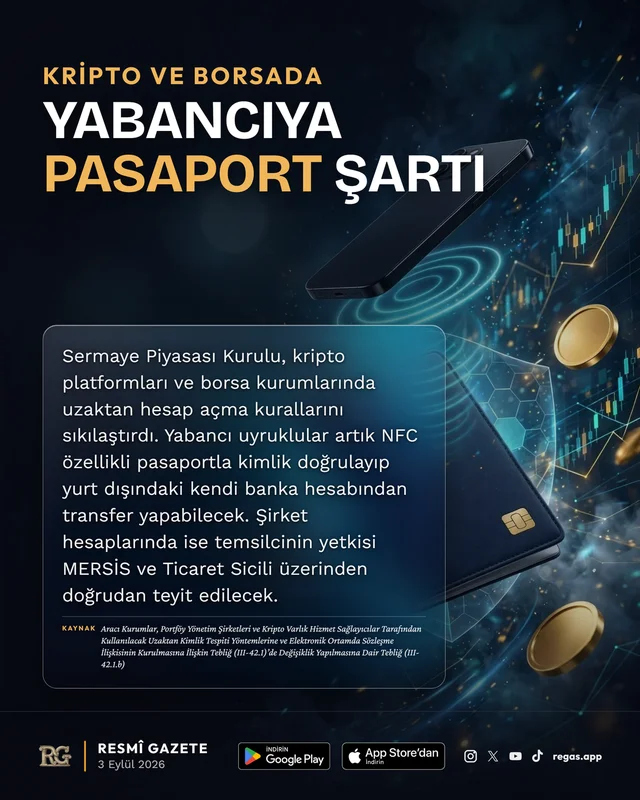
For natural persons who are not Turkish nationals, remote identification using an NFC-enabled passport in compliance with the ICAO 9303 standard has become mandatory. Address confirmation, technical data assessment and identification processes involving video calls have been introduced. These persons will be monitored in the high-risk group and will be able to make transfers only from their own bank accounts abroad. For juridical persons, additional steps have been introduced, including identification of the representative, verification through MERSİS and the Trade Registry Gazette, checking signature circulars, and identification of the beneficial owner. The definitions of “person” and “juridical person” have been expanded.
Details of the Regulation
The Communiqué amends the Communiqué on Remote Identification Methods to Be Used by Intermediary Institutions, Portfolio Management Companies and Crypto Asset Service Providers and on the Establishment of a Contractual Relationship in the Electronic Environment (III-42.1), published in the Official Gazette dated 8/2/2022 and numbered 31744. Through the amendments, the definition of “person” has been expanded to include the natural person subject to remote identification, the natural-person trader or the natural person authorized to represent a juridical person, and the definitions of important concepts such as “beneficial owner”, “Central Trade Registry System (MERSİS)”, “Trade Registry Gazette” and “juridical person” have been clarified. These definitions will serve as reference points, particularly in the remote identification processes of juridical persons.
Questions You Might Have
- What new steps will a natural person who is not a Turkish national encounter when wishing to open an account with a crypto asset service provider in Türkiye?
- Remote identification will be carried out using an NFC-enabled passport, confirmation of the address will be requested, technical data will be assessed on a risk-based basis, and funds will be transferred to the person’s account only by SWIFT from their own bank account abroad.
- When a juridical person opens an account remotely with an intermediary institution, how will the representative’s authority be verified?
- The representative will be identified, their authority to represent will be verified by matching it against current information obtained from MERSİS and/or the Trade Registry Gazette, and the beneficial owner will be identified.
- Will there be a special monitoring status for persons who are not Turkish nationals and are subject to remote identification?
- Yes, natural persons who are remotely identified using a passport will be monitored in the high-risk group, and money transfers relating to their accounts will be subject to scrutiny.
- Which institutions does this Communiqué directly affect?
- It directly affects intermediary institutions, portfolio management companies and crypto asset service providers.
Key Terms
- Uzaktan Kimlik Tespiti
- The process of verifying the identity of a person or institution electronically without physically coming together.
- Kripto Varlık Hizmet Sağlayıcısı
- Institutions that provide services such as the purchase, sale and custody of crypto assets.
- Gerçek Faydalanıcı
- The natural person who ultimately controls or benefits from a juridical person or asset.
- MERSİS
- The Central Trade Registry System; the digital platform on which the registry records of all commercial companies and other commercial enterprises in Türkiye are kept.
- NFC (Yakın Alan İletişimi)
- A technology that enables two electronic devices to communicate wirelessly over a short distance; it is used to read the information on the passport chip.
Affected Sectors
- Capital markets
- Crypto-asset service providers
- Finance
- Brokerage services
Where we posted this
Follow Turkish legal developments
REGAS analyzed all 32 items in the Official Gazette of 3 September 2026; we published only 2 of them here.
REGAS summarizes every change in the Turkish Official Gazette in plain language and notifies you.
The REGAS app is currently Turkish-only. If you would like English in the app, the best way to make it happen is to support the developer: get the app and just say so.


REGAS Commentary
This Communiqué aims to enhance security and international compliance in the digitalizing financial and crypto asset markets. In particular, it seeks to minimize risks such as money laundering and terrorist financing by regulating remote access to financial services by individuals who are not Turkish nationals and by juridical persons. While imposing new compliance obligations on financial institutions and crypto asset service providers, it also provides international clients with a more transparent and definite identification process. Practices such as high-risk group monitoring and restricted money transfers aim to prevent possible abuses by tightening the supervision of such transactions.