
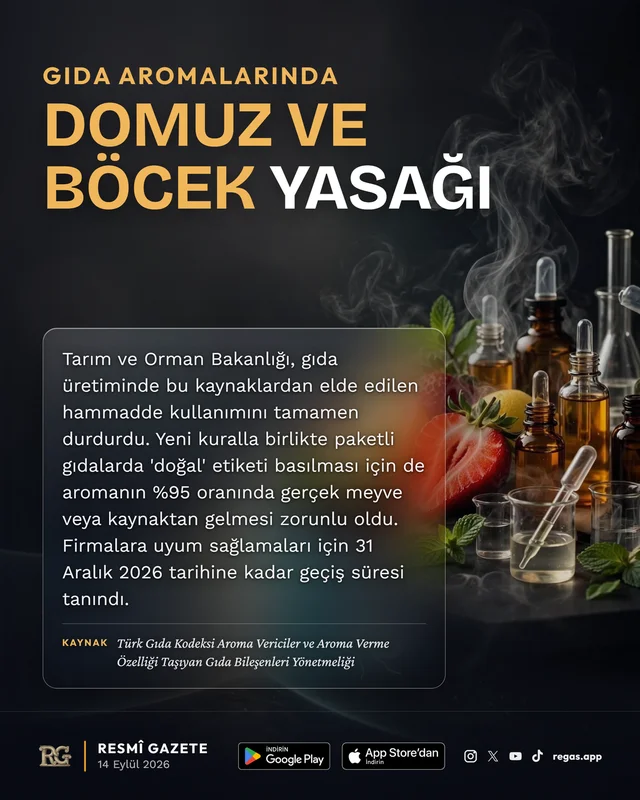
Ban on Pork and Insects in Food Flavourings
Official titleRegulation on the Turkish Food Codex Concerning Flavourings and Food Components with Flavouring Properties
The Ministry of Agriculture and Forestry has issued a new regulation reorganizing the conditions of use, source materials, and labelling rules for flavourings and components used in foods.
Before
The use of natural flavourings was subject to less stringent rules, and there was no provision as clear as this concerning the prohibition on pork and insects.
After
Flavouring materials of pork and insect origin were prohibited; a requirement was introduced that the “natural flavouring” label indicate at least 95% source material; and certain hazardous substances with FL codes will be completely prohibited at the end of 2026.
Details of the Regulation
The new regulation repeals the previous regulation dated 2011 and covers a broad range of matters from the production of flavourings to their labelling. The primary purpose of the regulation is to ensure food safety, protect consumer health, and prevent misleading practices in the use of flavourings. Although the regulation covers flavouring substances, smoke flavourings, and their source materials, it excludes simple substances having only a sweet, sour, or salty taste and unprocessed foods.
One of the most critical amendments is the strict prohibition on the use of substances of pork and insect origin in the production of flavourings and source materials. It also prohibits food flavourings from being placed on the market under alcoholic beverage names and imposes restrictions to prevent consumers from being misled about the use of flavourings at retail outlets. For substances assigned specific chemical codes (FL numbers), risk assessment and special restrictions on use have been established.
As for labelling, the use of the term “natural” is subject to very strict conditions. For a flavouring to be labelled “natural,” all of its components must be natural. For a flavouring to be designated by the name of a particular fruit, such as “natural apple flavouring,” at least 95% of the flavouring by weight must be obtained from that fruit. The remaining 5% may be used only for standardization or freshness.
The regulation grants food business operators a transition period until 31 December 2026 to achieve compliance. However, from that date, the use of certain specific flavouring substances (FL 04.029, FL 05.100, etc.) and the importation of foods containing such substances will be completely prohibited. Products manufactured and placed on the market by the end of 2026 will be permitted to remain on sale until the end of their shelf life.
Questions You Might Have
- Could a “strawberry-containing” product that I buy from the supermarket now contain traces of pork or insects?
- No. Article 5 of the new regulation strictly prohibits the use of flavouring materials of pork and insect origin in foods.
- What does the warning “Keep away from light” on a flavouring mean?
- Under the regulation, the warning is mandatory for the flavouring substance numbered FL 16.133 because its structure changes upon contact with light (photoconversion).
- Will foods manufactured under the old rules be recalled immediately?
- No. Businesses have been granted a transition period until 31 December 2026; products manufactured before that date may remain on the market until the end of their shelf life.
Key Terms
- FL Numarası
- A unique identification number used by the European Union to identify flavouring substances.
- Aroma Öncülü
- A substance added to food that creates a flavour when subjected to a process such as cooking, but is not required to have an odour of its own.
- Tütsü Aroma Vericisi
- A product obtained by concentrating and purifying wood smoke to give foods a smoked flavour.
Affected Sectors
- Food industry
- Flavouring and fragrance producers
- Retail supermarket chains
- Food importers
Where we posted this
Follow Turkish legal developments
REGAS analyzed all 23 items in the Official Gazette of 14 September 2026; we published only 1 of them here.
REGAS summarizes every change in the Turkish Official Gazette in plain language and notifies you.
The REGAS app is currently Turkish-only. If you would like English in the app, the best way to make it happen is to support the developer: get the app and just say so.


REGAS Commentary
With this regulation, the term “natural flavouring,” which we frequently encounter on food labels, acquires a genuine meaning. When you eat a yoghurt labelled “with natural strawberry flavouring,” you can now be sure that the flavouring is genuinely derived from strawberries at a rate of 95%. Furthermore, the prohibition on flavouring components of pork and insect origin provides an important assurance for citizens with religious sensitivities.