
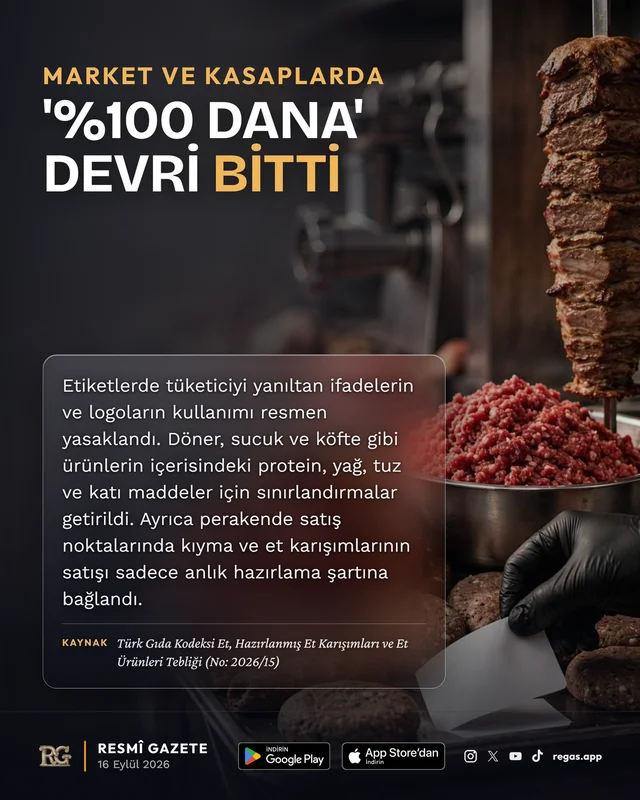
The Era of “100% Beef” in Supermarkets and Butcher Shops Has Ended
Official titleTürk Gıda Kodeksi Et, Hazırlanmış Et Karışımları ve Et Ürünleri Tebliği (No: 2026/15)
This Communiqué, published by the Ministry of Agriculture and Forestry, aims to update food safety and consumer information by introducing new rules concerning the production, packaging, and placing on the market of raw meat, minced meat, prepared meat mixtures, and meat products.
Before
The Türk Gıda Kodeksi Et, Hazırlanmış Et Karışımları ve Et Ürünleri Tebliği (Tebliğ No: 2018/52), published in the Resmî Gazete dated 29/1/2019 and numbered 30670, was in force, and food business operators remained subject to these provisions until they complied with the new Communiqué.
After
The technical and hygienic rules concerning the production, packaging, and placing on the market of raw meat, minced meat, poultry mince, prepared meat mixtures, mechanically separated poultry meat, and meat products have been re-established. Product definitions, compositional limits, retail sale conditions, and labeling principles have been updated. In particular, the mixing of meats from different animal species, the use of offal, protein, fat, and collagen ratios, the specifications of products such as döner and sucuk, and the requirements for retail establishments have been set out in detail.
Details of the Regulation
This Communiqué provides a comprehensive update by repealing the previous Türk Gıda Kodeksi Et, Hazırlanmış Et Karışımları ve Et Ürünleri Tebliği (Tebliğ No: 2018/52), which was published in the Resmî Gazete dated 29/1/2019 and numbered 30670. The Communiqué details the technical characteristics, compositional standards, production methods, and labeling rules for raw meat, minced meat, poultry mince, prepared meat mixtures, mechanically separated poultry meat (MAKE), and various meat products obtained from animals slaughtered for meat. New definitions and compositional limits have been established for popular meat products such as burgers, döner, sucuk, pastırma, and ham. For example, restrictions have been introduced on the ratios of fat, salt, total meat protein, and collagen connective tissue protein in products such as minced meat, köfte, burgers, and döner. It has also been specified that poultry mince and prepared poultry meat mixtures may only be placed on the market in frozen form.
Questions You Might Have
- What important changes were made to the content of döner under the new Communiqué?
- The fat content of döner has been limited to a maximum of %25 by mass, while its salt content has been limited to a maximum of %2. In addition, the use of ingredients such as peanuts, cheese, and dietary fiber (in leaf döner) in döner production has been prohibited, and restrictions have been introduced on protein-, starch-, and soy-based filling materials.
- Will we still be able to see meat products containing statements such as “100% beef” in supermarkets?
- No. Under Article 18 of the Communiqué, the use of expressions or logos such as “%100,” “%100 beef,” or “%100 breast meat,” including on product labels, is prohibited. This is intended to prevent consumers from being misled.
- How will minced meat and prepared meat mixtures be sold in retail establishments?
- In retail establishments, minced meat, poultry mince, and prepared meat mixtures (except for köfte and regional products) may only be placed on the market when prepared immediately upon consumer request. Only uncooked köfte and regional products may be produced and sold daily as prepared meat mixtures.
- For which meat products has the addition of additives been strictly prohibited?
- Under the new Communiqué, the addition of any food additives to kavurma and minced meat kavurma products has been strictly prohibited. The addition of smoke flavorings to sucuk, heat-treated sucuk, pastırma, minced meat kavurma, kavurma, döner, and poultry meat döner has also been prohibited.
Key Terms
- Tebliğ
- In the Turkish legal system, these are regulatory administrative instruments issued to demonstrate the application of a statute or explain a matter, ranking below regulations.
- Türk Gıda Kodeksi
- This is the entirety of the legislation published by the Ministry of Agriculture and Forestry that establishes technical and hygienic rules on matters such as the safety, quality, and labeling of foods.
- Kolajen Bağ Doku Proteini
- This is a type of protein found in the connective tissues of meat, and its not exceeding a certain percentage of the total protein content of the meat is important for product quality. A high collagen content may affect the nutritional value and chewiness of meat.
- Mekanik Ayrılmış Kanatlı Eti (MAKE)
- This is a product obtained by mechanically separating the meat from the carcasses of poultry using methods that cause the muscle fibers to lose or change their structure. Under this Communiqué, it may not be used in red meat products and may only be used in poultry emulsified meat products subject to certain restrictions.
- Fermentasyon
- This is the process of converting carbohydrates in foods into organic compounds through the action of microorganisms. It plays an important role in the ripening of meat products such as sucuk and in the formation of their characteristic flavors.
Affected Sectors
- Food production
- Retail food
- Meat industry
- Restaurants and catering
- Livestock farming
Where we posted this
Follow Turkish legal developments
REGAS analyzed all 31 items in the Official Gazette of 16 September 2026; we published only 7 of them here.
REGAS summarizes every change in the Turkish Official Gazette in plain language and notifies you.
The REGAS app is currently Turkish-only. If you would like English in the app, the best way to make it happen is to support the developer: get the app and just say so.


REGAS Commentary
This Communiqué will directly affect all stakeholders in the meat and meat product sector, namely producers, retailers, and consumers. Content and quality standards for products will become more transparent for consumers, who will be expected to have more accurate information about the products they purchase, particularly through the labeling rules. Businesses, on the other hand, are required to bring their production processes and product labels into compliance with the provisions of the new Communiqué. For example, restrictions on the content and production processes of products such as döner and sucuk will increase product quality and safety while protecting consumers by prohibiting the use of misleading expressions such as “100% beef.” This will create a fairer competitive environment in the sector and raise food safety standards.