
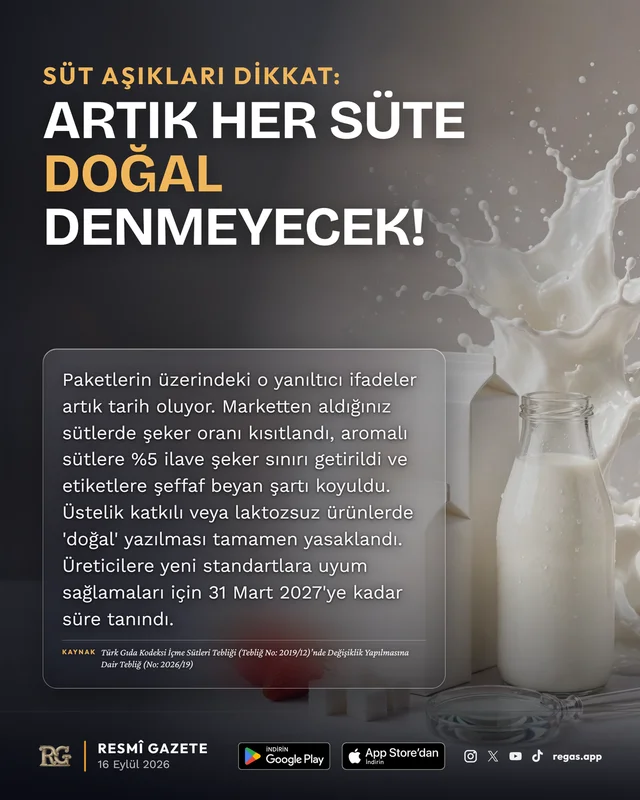
Dairy Farmers, Attention! from Now on, Not Every Milk Will Be Allowed to Be Called “Natural”!
Official titleCommunique Regarding Amendments to the Turkish Food Codex Drinking Milk Communiqué (Communique No: 2019/12) (No: 2026/19)
This Communiqué has introduced new standards for the composition, flavoring and sugar content, and labeling rules of drinking milk by making extensive amendments to the Turkish Food Codex Drinking Milk Communiqué. In particular, clear limits have been set for added sugar, flavoring ingredients, and milk fat content, while the use of the term “natural” has also been restricted.
Before
The definition of flavoring ingredients in drinking milk was previously more limited. There were no express upper limits for added sugar or total sugar content. The rules concerning the use of flavorings either made cross-references to a separate regulation or were general in nature. The milk fat classifications and labeling details differed from those in the updated version. There were no restrictive rules concerning the use of the term “natural.”
After
The definition of flavoring ingredients has been expanded to include vegetables and fruits. The proportion of added sugar has been limited to a maximum of 5% by mass, and the total sugar content has been limited to a maximum of 9.5% by mass. It has been stipulated that only natural flavorings may be used in products. Drinking milk will be classified according to the new fat contents set out in EK-2, and this information must be indicated on the label. The term “natural” may be used only for full-fat and fat-containing milk that contains no additives, flavoring ingredients, or flavorings, and may not be used for lactose-free milk.
Details of the Regulation
This Communiqué, published by the Ministry of Agriculture and Forestry, has made extensive amendments to the Turkish Food Codex Drinking Milk Communiqué No. 2019/12. Its primary objective is to subject the production, processing, packaging, storage, transportation, and placing on the market of drinking milk to clearer rules and to protect consumer health. The amendments have particularly expanded the definition of flavoring ingredients to include flavorings such as vegetables and fruits, and their juices, pulps, purées, and concentrates, in addition to honey, cocoa, and chocolate. Through these regulations, the use of only natural flavorings has been permitted and compliance with the provisions of the relevant Turkish Food Codex Regulation on Flavorings and Food Ingredients That impart a Flavour has been made mandatory.
One of the most notable innovations introduced by the Communiqué concerns restrictions on the proportions of sugar that may be added to drinking milk. Accordingly, the total proportion of flavoring ingredients used in flavored drinking milk must be at least 1% by mass, the proportion of added sugar must not exceed 5% by mass, and the total sugar content of the product must not exceed 9.5% by mass. Furthermore, the types of sugar that may be used must comply with the standards defined in the Turkish Food Codex Sugar Communiqué, which include semi-white sugar, white sugar, and extra-white sugar. This regulation is considered an important step in enabling consumers to control their sugar intake.
Significant innovations have also been introduced into the labeling rules. The labels of drinking milk containing sugar must prominently bear the statement “contains ...% added sugar.” The classification of drinking milk according to its fat content, full-fat, fat-containing, semi-fat, and fat-free, and the indication of this classification on the label have also been further detailed, and the placing on the market of drinking milks with different fat contents outside the classification set out in EK-2 has been prohibited. Most importantly, strict rules have been introduced regarding the use of the term “natural”; this term may be used only for full-fat and fat-containing drinking milks that contain no additional components whatsoever, such as additives, flavoring ingredients, or flavorings. The term “natural” may not be used for lactose-free or reduced-lactose milk. Food businesses have been granted until 31 March 2027 to comply with these new provisions.
Questions You Might Have
- How much sugar may drinking milk contain under the new Communiqué?
- The proportion of sugar that may be added to the product may be at most 5% by mass, and the total sugar content of the product may not exceed 9.5% by mass.
- May the term “natural milk” be used for every type of drinking milk?
- No. It may be used only for full-fat and fat-containing drinking milks that contain no additional components whatsoever, such as additives, flavoring ingredients, or flavorings. It may not be used for lactose-free or reduced-lactose milk.
- By when must food businesses comply with these amendments?
- Food businesses must comply with the new provisions introduced by this Communiqué by 31 March 2027.
Key Terms
- Çeşni Maddesi
- Edible foods such as honey, cocoa, chocolate, vegetables, and fruits, and their juices, pulps, purées, and concentrates, used to impart flavor to drinking milk.
- Aroma Vericiler
- Substances or mixtures added to a food to impart an aroma or taste. Under this Communiqué, only natural flavorings are permitted.
- İlave Şeker
- Types of sugar added externally to a food during the production stage. The Communiqué sets an upper limit on this proportion in drinking milk.
- Uyum Süresi
- The period of time granted to the relevant persons or institutions to prepare for and commence the implementation of a newly introduced statutory provision.
Affected Sectors
- Food industry
- Dairy producers
- Retail food sector
- Consumers
Where we posted this
Follow Turkish legal developments
REGAS analyzed all 31 items in the Official Gazette of 16 September 2026; we published only 7 of them here.
REGAS summarizes every change in the Turkish Official Gazette in plain language and notifies you.
The REGAS app is currently Turkish-only. If you would like English in the app, the best way to make it happen is to support the developer: get the app and just say so.


REGAS Commentary
This Communiqué contains important regulations that will enable consumers to make more informed choices regarding drinking milk. In particular, limiting the proportion of added sugar and requiring clear declarations on labels will provide substantial benefits to citizens who are particularly concerned about healthy nutrition. The restrictions on the use of the term “natural” aim to prevent misleading expressions in product marketing. For food businesses, the compliance period designated to enable them to adapt their production processes and labeling practices to the new regulations, 31 March 2027, must also be taken into consideration.