
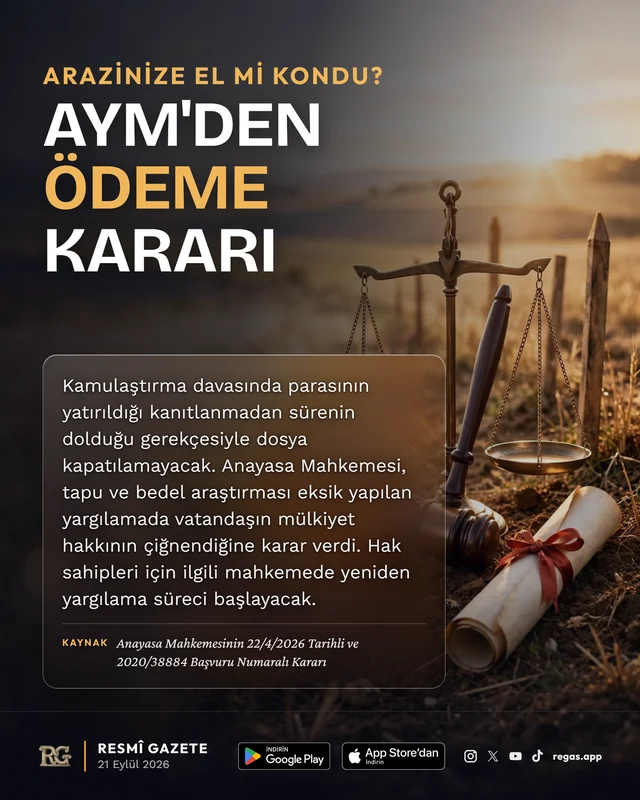
Did They Encroach on Your Property? Constitutional Court Decision on Payment
Official titleDecision of the Constitutional Court dated 22/4/2026, Application No. 2020/38884
The Constitutional Court ruled that the right to property had been violated because the local courts did not sufficiently examine the allegations raised by the heirs in a lawsuit for dispossession without expropriation that the expropriation compensation had not been paid. After the application was terminated due to the death of one of the applicants, the file was referred to the relevant court for retrial on behalf of the other applicants.
Details of the Regulation
The case underlying the application is based on the allegation that, although the immovable properties located in Malatya were registered as deedless property in the name of the applicants’ predecessor, they were expropriated by Türkiye Şeker Fabrikaları A.Ş. in 1954. The applicants argued that the immovable properties had not been expropriated in accordance with the procedure and that the compensation had not been paid, and therefore filed a compensation lawsuit on grounds of dispossession without expropriation. Malatya 3rd Civil Court of First Instance, the court of first instance, dismissed the case on procedural grounds, holding that the immovable properties had been expropriated before 1956 and that the lawsuit had not been filed within the two-year limitation period under the Act dated 1961. The local court decisions were also upheld during the appeal on facts and law and appeal on points of law proceedings. The Gaziantep Regional Court of Appeal, 5th Civil Chamber, and the Court of Cassation (Yargıtay), 5th Civil Chamber, found the dismissal of the lawsuit appropriate on the ground that the ten-year limitation period under Article 12 of Law No. 3402 on the Cadastre had been exceeded.
The Constitutional Court decided to terminate the application with respect to Müktat Gürcü, one of the applicants, because he died on 25/8/2024, after the date of the individual application. However, the Court also recalled the principle that, in order for the heirs of applicants who die after filing an individual application not to lose their rights, it may consider their requests to continue the application.
As for the other applicants, the Constitutional Court found that the judicial authorities had not made any assessment regarding the allegations that the expropriation compensation had not been paid. As also shown by the letters obtained by the applicants from Türkiye İş Bankası and the Central Bank of the Republic of Türkiye, it was understood that no sufficient and appropriate reasoning had been provided as to whether the expropriation compensation had been paid. This means that the procedural safeguards for the protection of the right to property had not been complied with and that the fair balance had been disrupted to the detriment of the applicants. In light of these findings, the Constitutional Court ruled that the right to property, protected under Article 35 of the constitution, had been violated.
It was decided that, in order to remedy the consequences of the violation, the file be referred to Malatya 3rd Civil Court of First Instance for retrial, and the applicants’ compensation claims were dismissed on the ground that retrial would remedy the violation. The applicants were jointly awarded litigation costs of 40.446,90 TL.
Questions You Might Have
- Why do courts apply limitation periods so strictly in cases of dispossession without expropriation?
- Courts generally apply the limitation periods specified in the legislation strictly in order to ensure legal certainty and administrative stability. However, the Constitutional Court emphasizes that, in order for these practices not to violate the right to property, the allegations must be assessed on their merits.
- Why was the route of retrial followed instead of payment of compensation following the Constitutional Court’s decision?
- The Constitutional Court ruled that, depending on the nature of the violation, retrial would provide an adequate remedy for remedying its consequences. This requires the local court to examine on their merits whether the expropriation compensation has been paid and to render a new decision.
- How did the death of applicant Müktat Gürcü affect the application? Could his heirs not have filed the lawsuit?
- Following the death of Müktat Gürcü after the individual application, his application was terminated. However, the Constitutional Court stated that the application could continue to be examined if the heirs demonstrated their intent to pursue it. In this case, it falls upon the heirs of the deceased applicant to file a new application on their own behalf or to submit a request to continue the existing application.
- In which situations is it accepted that the right to property has been violated?
- For an interference with the right to property to be consistent with the constitution, it must be based on law, pursue the public interest, and be carried out with regard to the principle of proportionality. As in this decision, the failure of the judicial authorities to assess a fundamental issue, such as whether the expropriation compensation has been paid, is accepted to constitute a violation of the right to property.
Key Terms
- Kamulaştırmasız El Atma
- It is the situation where an administration takes de facto possession of private property without complying with the statutory expropriation procedures or paying compensation, and uses it for a public service.
- Hak Düşürücü Süre
- It is the period within which the non-use of a right results in the complete loss of that right. Once this period has expired, the right can no longer be asserted.
- Mülkiyet Hakkı
- It is the fundamental human right to possess something and to use, enjoy, and dispose of it, protected under Article 35 of the constitution.
- Yeniden Yargılama (Giderim)
- It is the order by which, upon determining a violation of a right, the Constitutional Court refers the file to the court that rendered the decision causing the violation, with instructions to conduct a retrial, in order to remedy the consequences of the violation.
- İşlemden Kaldırma
- It is the dismissal of an application without examining its merits due to reasons such as the failure of the application requirements or the withdrawal of the application by the applicant.
Where we posted this
Follow Turkish legal developments
REGAS analyzed all 32 items in the Official Gazette of 21 September 2026; we published only 4 of them here.
REGAS summarizes every change in the Turkish Official Gazette in plain language and notifies you.
The REGAS app is currently Turkish-only. If you would like English in the app, the best way to make it happen is to support the developer: get the app and just say so.


REGAS Commentary
This decision provides an important safeguard for the protection of the right to property against State interventions such as expropriation. For citizens, it demonstrates, in particular, that full payment of the compensation in compliance with the procedure during expropriation proceedings is a legal requirement and that otherwise avenues for seeking remedies may extend as far as the Constitutional Court. The decision emphasizes that, as well as the application of limitation periods in judicial proceedings, substantive allegations, such as whether expropriation compensation has been paid, must be examined meticulously. The retrial decision may offer hope to property owners in similar situations and may establish a precedent in cases concerning the right to property.